
Conditions of Confinement
Plaintiffs in this case are two youth who sought compensatory and punitive damages, and declaratory and injunctive relief for injuries they suffered while in the custody of New Jersey’s “Juvenile Justice Commission”. The harms that were alleged included excessive room isolation, deprivation of basic necessities such as proper clothing, and lack of access to mental…

On March 31, 2011, the Department of Justice released the findings of their investigation into the Leflore County Juvenile Detention Center (LCJDC) in Greenwood, Mississippi. The DOJ found that “[o]ur investigation revealed systemic, egregious and dangerous abuses perpetuated by a lack of accountability and controls.” The DOJ investigation uncovered that LCJDC fails to prevent unconstitutional…
This amici brief by Juvenile Law Center, Rutgers Legal Clinic, The Gault Center, and others argues trial courts retain jurisdiction post-disposition to modify or change dispositional orders that are contrary to the purpose of the juvenile code. Further, the brief argues trial courts must provide oversight to ensure the safety of young people in abusive…

This amicus brief by Juvenile Law Center and The Gault Center argues Illinois automatic transfer law does not comply with recent research and findings on adolescent development as recognized by the Supreme Court jurisprudence in Roper and Graham. Further, amici argue the state’s automatic transfer statute violates the proportionality clause of Article I, Section 11…

On December 12, 2010, the Memorandum of Agreement (MOA) between Los Angeles County and the United States regarding the Los Angeles County Probation Camps was amended a second time. The amended MOA recognizes that the County implemented significant reforms and achieved substantial compliance with all but four paragraphs of the MOA, and thus extends the…

On October 31, 2010, Los Angeles County entered into a Memorandum of Agreement (MOA) with the United States to address the DOJ’s investigation findings into the Los Angeles County Probation Camps. The MOA provisions include implementing new policies that govern the use of force, restricting the use of chemical sprays, creating a system of review…

On July 14, 2010, the DOJ entered into a settlement agreement with the State of New York to remedy constitutional violations in the juvenile facilities. The settlement agreement outlines that the state shall not subject youth to undue restraints and must provide adequate and appropriate mental health care and treatment to youth. Related actions: [New…

On July 14, 2010, the DOJ filed a complaint in the U.S. District Court for the Northern District of New York against the State of New York, alleging that the state “disregarded known or serious risks of harm to youths at the Facilities . . . . constituting a pattern or practice that violates the…

On March 29, 2010, the Memorandum of Agreement (MOA) between Los Angeles County and the United States regarding the Los Angeles County Probation Camps was amended. The amended MOA includes language outlining that “The Monitor shall ensure that the subset of the Monitoring Team that participates in these visits has the requisite experience and expertise…

On January 29, 2010, the Department of Justice issued a findings letter regarding an investigation of the Indianapolis Juvenile Correctional Facility (ICJF) pursuant to the Civil Rights of Institutionalized Persons Act, 42 U.S.C. § 1997 (CIPRA), and the pattern or practice provision of the Violent Crime Control and Law Enforcement Act of 1994, U.S.C. §14141…

On November 23, 2009, the DOJ and the Ohio Department of Youth Services entered into an amended consent decree to address the remaining conditions of confinement in the Scioto Juvenile Correctional Facility, following the closure of the Marion Juvenile Correctional Facility. Related Actions: [Ohio] Marion Juvenile Correctional Facility: Investigation [Ohio] DOJ Complaint in U.S. v.…

On August 14, 2009, the DOJ released its investigation of four juvenile facilities in New York, finding that conditions violate federal and constitutional rights of youth. Specifically, the investigation highlights the facilities’ use of excessive force and inappropriate restraints and its failure to provide adequate mental health care and treatment for youth, in violation of…

On October 31, 2008, the Department of Justice released their findings report after an investigation into the Los Angeles County Probation Camps (“the Camps”). The DOJ found that “[y]outh residing in Los Angeles County’s Camps are not adequately protected from harm . . . and the County fails to provide adequate suicide prevention and mental…

On May 16, 2008, the DOJ filed a complaint against the State of Ohio in the Southern District of Ohio Eastern Division for engaging in a pattern or practice of constitutional violations in juvenile facilities. Specifically, the complaint alleges that the state has engaged in a pattern or practice of violating young people’s right to…
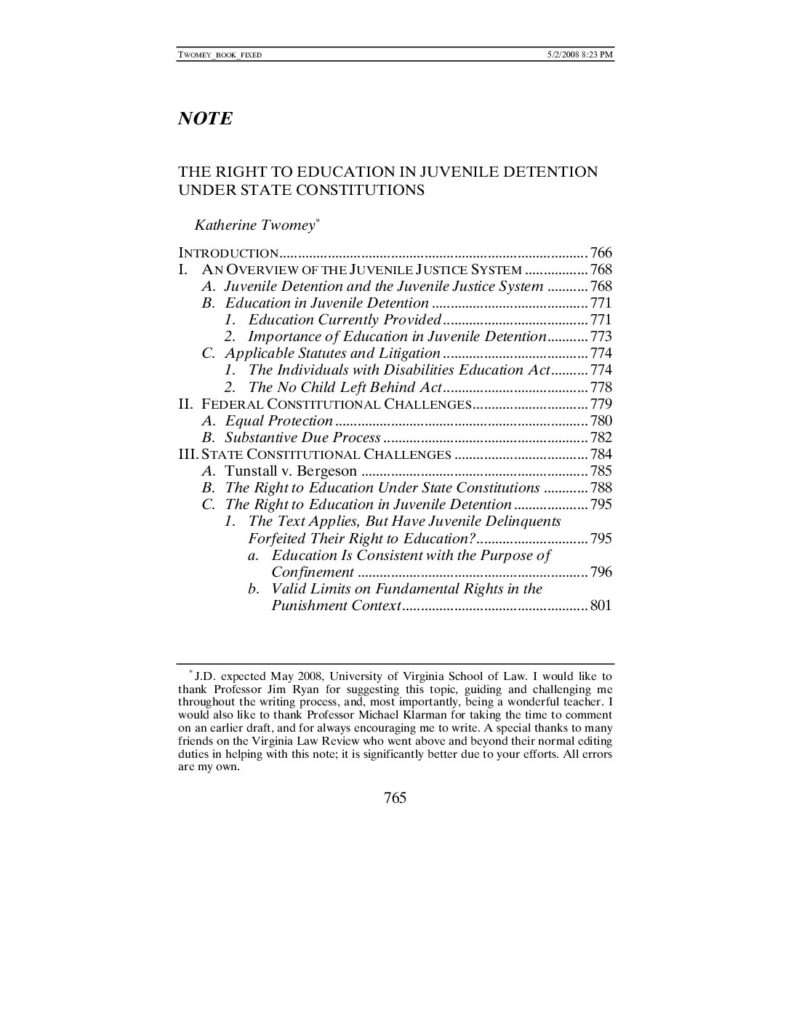
From the introduction: “This Note will argue that children in juvenile detention have a right to an adequate education based on state constitutional guarantees of education. This right can be used to challenge the inadequacy of the current educational services provided in juvenile detention facilities. The argument will proceed in three parts. Part I will…

On May 9, 2007, the DOJ released its investigation of the Marion County, Ohio Juvenile Correctional Facility, finding that the conditions violate federal and constitutional rights of youth. Specifically, the investigation highlights violations of young people’s right to reasonable safety, right to adequate mental health care, and right to special education services. Related actions: [Ohio]…

On May 9, 2007, the DOJ released its investigation of the Scioto Juvenile Correctional Facility, finding that the conditions violate federal and constitutional rights of youth. Specifically, the investigation highlights violations of young people’s right to reasonable safety, right to adequate mental health care, and right to special education services. Related actions: [Ohio] Marion Juvenile…

From the introduction: “This brief tells the story of how the four Models for Change states—Pennsylvania, Illinois, Louisiana, and Washington—are already moving to reform and reshape their own state juvenile justice systems. These states have demonstrated strong leadership in juvenile justice policy, value collaboration and engagement, and because of their efforts, have changed the political…
From the Conclusion: “For too long, LGBT young people in the child welfare and juvenile justice systems have been overlooked, ignored and mistreated. Because of the hard work of hundreds of advocates who have come together through coordinated national efforts, a cultural shift has begun. These advocates are creating effective nondiscrimination policies, best practices guidelines,…


From the introduction: “In this Pathway we explore why youth of color are overrepresented in the juvenile detention system and review what has been done in some sites to reduce the number of minority youth in detention. Dealing with disparity in the use of detention has been one of the most challenging pieces of the…
From the introduction: “Building Blocks for Youth, a national initiative to promote a fair and effective youth justice system, commissioned this report to determine whether it is possible to reduce the number of youth in secure detention and place young people who have gotten in trouble with the law in community programs, without incurring an…
