
Disposition


On August 10, 2012, the U.S. Department of Justice released a findings report regarding their investigation of Lauderdale County Youth Court, Meridian Police Department, and Mississippi Division of Youth Services. The findings included the following violations: “(1) The City of Meridian Violates the Fourth Amendment by Arresting Children Without Assessing Probable Cause; (2) Lauderdale County…

In the case of C.P, the Ohio Supreme Court ruled that R.C. 2152.86, which created a new class of youth adjudicated of sex offenses who would automatically be subject to mandatory, lifetime sex-offender registration and notification requirements, violated the U.S. and Ohio Constitutions. In its ruling, the Court offered the following language in support: “In…

This amicus brief by Loyola Civitas ChildLaw Center, Juvenile Law Center, The Gault Center, and others argues there is a per se conflict of interest when a child’s defense attorney also acts as their guardian ad litem. The brief argues the guardian ad litem’s ethical and legal obligation to act in the child’s “best interest”…

On December 12, 2010, the Memorandum of Agreement (MOA) between Los Angeles County and the United States regarding the Los Angeles County Probation Camps was amended a second time. The amended MOA recognizes that the County implemented significant reforms and achieved substantial compliance with all but four paragraphs of the MOA, and thus extends the…
This amicus brief prepared by Juvenile Law Center, The Gault Center, and others argues the 6th Amendment protects the right to jury trials in juvenile court sentencing hearings resulting in serious adult sentences. Amici argue the New Mexico Supreme Court should affirm the Court of Appeals’ judgment and find that the rule from Apprendi applies…
In New Mexico v. Jones, the New Mexico Supreme Court held that before an adult sentence is imposed on a young person based on the state’s “Youthful Offender” status, which enables either a juvenile or adult sentence, an amenability hearing must first be held to determine whether a young person is amenable to rehabilitation or treatment in the juvenile legal system. The court offered the following language in support: …
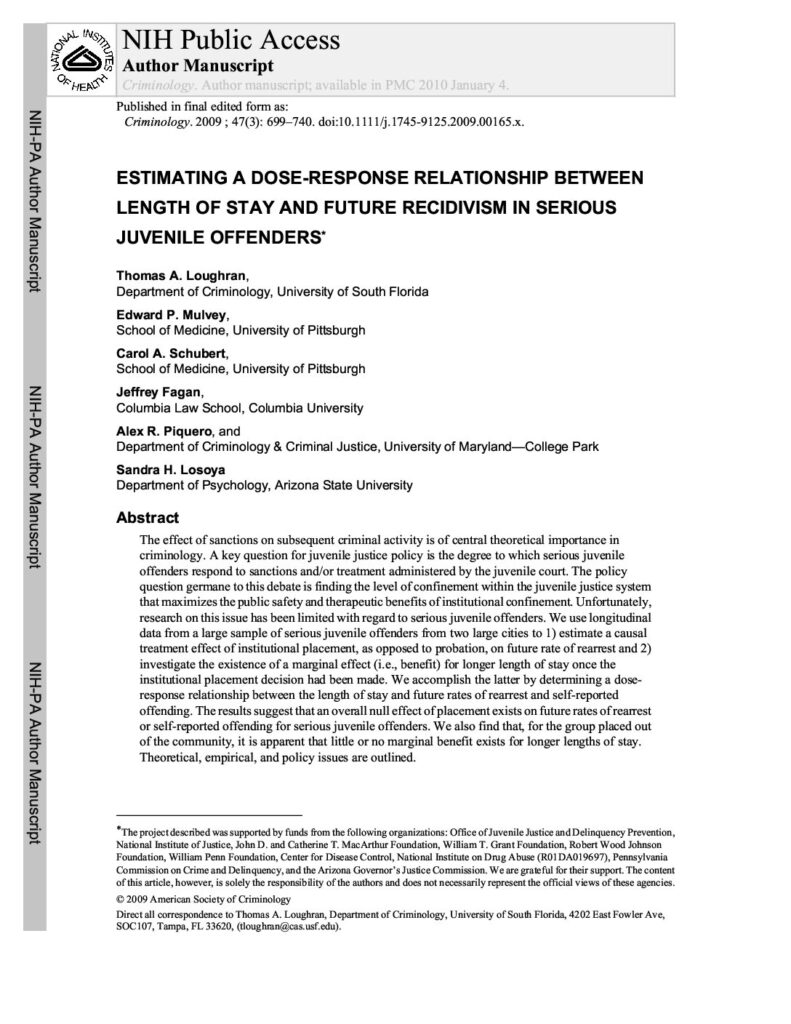
From the Abstract: “The effect of sanctions on subsequent criminal activity is of central theoretical importance in criminology. A key question for juvenile justice policy is the degree to which serious juvenile offenders respond to sanctions and/or treatment administered by the juvenile court. The policy question germane to this debate is finding the level of…

This amicus brief prepared by The Gault Center and Juvenile Law Center argues that Louisiana must grant jury trials in juvenile court given the persistent deficiencies in Louisiana’s juvenile legal system including the punitive nature of consequences youth face and the dire and harmful conditions of the state’s jails. Furthermore, amici argue there is a…


From the introduction: “In this Pathway we explore why youth of color are overrepresented in the juvenile detention system and review what has been done in some sites to reduce the number of minority youth in detention. Dealing with disparity in the use of detention has been one of the most challenging pieces of the…

From the introduction: “This policy brief will review the work done in one jurisdiction that has succeeded in reducing the number of minority youth detained pre-trial, summarize the lessons learned from innovations in Multnomah County, Oregon, and highlight their national significance. While the more general nationwide picture on reducing racial disparity in the juvenile justice…

This research from Building Blocks for Youth examines how adult court transfers impact youth in California. The researchers found that minority youth are 8.3 times more likely than white youth to be sentenced by an adult court to imprisonment in a California Youth Authority facility. From the report: ….At the present time, all 50 states…


The U.S. Supreme Court held that when mental health is a significant factor in an accused person’s defense, they must have the ability to hire an independent expert provided to the defense at the expense of the state if they cannot afford it. The Court reversed and remanded the holding of the Oklahoma Court of…


- « Previous
- 1
- …
- 5
- 6
- 7
