
Facility Staff

On November 15, 2018, a joint settlement was reached to address the conditions of confinement in Florida’s Palm Beach County Jail. The settlement agreement outlines comprehensive changes in the facility, including giving young people time and access to appropriate recreational activities outside of their cells during school hours. The settlement also limits the amount of…

On October 1, 2018, the DOJ filed a Statement of Interest in a federal class action lawsuit on behalf of young people confined in Florida’s Palm Beach County Jail. The DOJ highlights the protections afforded to students with disabilities under the Individuals with Disabilities Education Act (IDEA), and the “independent and shared” responsibilities and obligations…

On June 21, 2018, a federal class action lawsuit was filed on behalf of young people confined in the Palm Beach County Jail, alleging violations of their 8th and 14th Amendment rights under the U.S. Constitution. The plaintiffs are youth whose cases have been direct-filed in adult court in Palm Beach County, Florida. The complaint…

On October 17, 2017, the DOJ closed its investigation of the Pendleton Juvenile Correctional Facility, citing improvements made to the facility. The letter states, “Most broadly, the State has made system-wide efforts to minimize incarceration of youth; to move toward a rehabilitative juvenile justice model; to increase youth’s access to community-based alternatives to incarceration; and…

This report by the Center for American Progress, Movement Advancement Project, and Youth First offers an overview of youth incarceration in the United States and in particular, data on the experiences and challenges of LGBTQ youth incarcerated in the juvenile legal system. It concludes with several recommendations for reducing system involvement, ensuring fair treatment within…

This policy report features interviews of young people who have been incarcerated in youth facilities in Colorado and details the harmful conditions and culture in these programs. From the Executive Summary: “Despite a mission of rehabilitation rather than punishment, the culture of the Colorado Division of Youth Corrections (DYC) is plagued by punitive practices that…
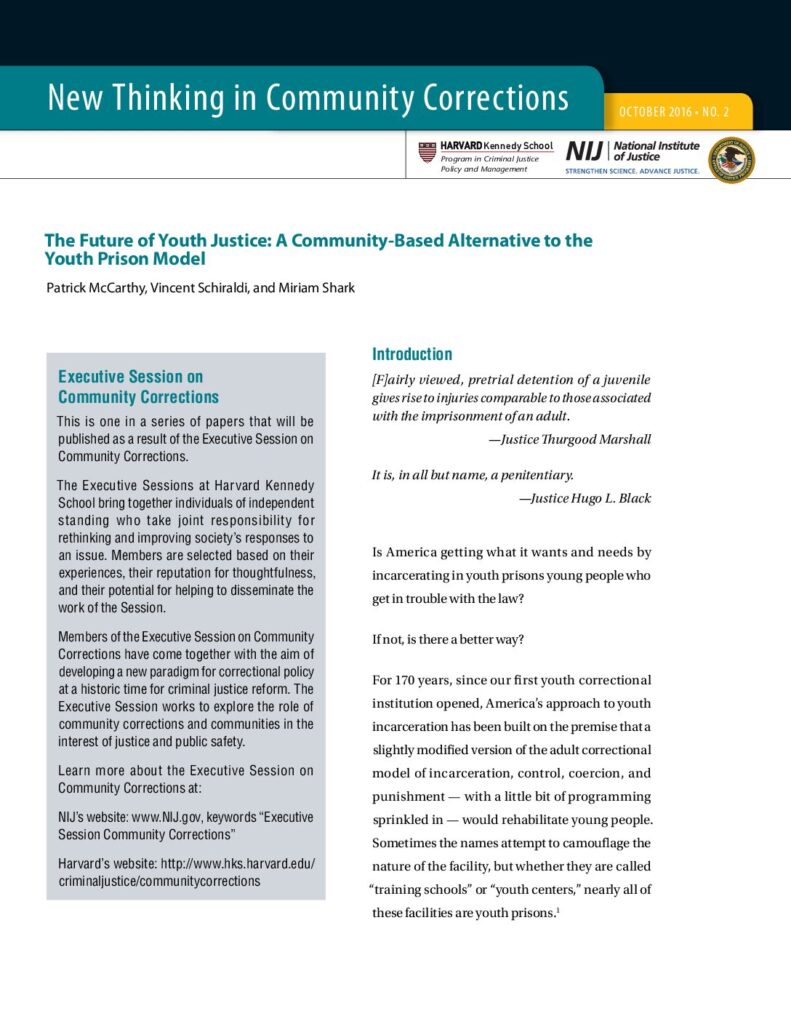
This paper from the Executive Session on Community Corrections at the Harvard Kennedy School examines the history of youth incarceration and discusses how the inherently flawed model of youth prisons demands systemic reforms, including closure of youth prisons, to actualize safer communities, and positive youth outcomes. From the introduction: “For 170 years, since our first youth correctional institution opened, America’s approach…

On December 9, 2015, the U.S. District Court for the Southern District of Ohio Eastern Division terminated the consent decree, finding the Ohio Department of Youth Services in substantial compliance with the consent decree. Notable improvements made to the Ohio juvenile facilities include: “meaningful grievance system and easy access to attorneys to address concerns related…

On March 31, 2011, Leflore County, Mississippi entered into a Memorandum of Agreement (MOA) with the United States to address the DOJ’s investigation findings into the Leflore County Juvenile Detention Center (LCJDC). The MOA outlines that LCJDC must provide young people with reasonably safe conditions of confinement, protect youth from harm, limit the use of…

On May 12, 2015, the DOJ filed a complaint in the U.S. District Court for the Northern District of Mississippi against Leflore County, Mississippi for engaging “in a pattern or practice of conduct that violates the Constitutional and statutory rights of youth at the Detention Center.” The complaint outlines 14th Amendment violations based on Leflore…

From the introduction: “This report will describe, dissect, and draw lessons from Connecticut’s striking success in juvenile justice reform for other states and communities seeking similar progress. The first section details the timeline and dimensions of change in Connecticut’s juvenile justice system over the past two decades. In 1992, Connecticut routinely locked up hundreds of…

On August 22, 2012, the DOJ released its investigation findings into the Pendleton Juvenile Correctional Facility in Indiana. The investigation finds that “Pendleton exposes incarcerated youth to significant harm in violation of their constitutional and federal statutory rights. Pendleton fails to take reasonable steps to prevent youth from committing suicide, fails to provide reasonably safe…

On March 20, 2012, the DOJ released its investigation findings into the conditions of confinement at the Walnut Grove youth Correctional Facility (WGYCF) in Walnut Grove, Mississippi. The investigation concludes, “the State of Mississippi is deliberately indifferent to the constitutional rights of young men confined at WGYCF. Evidence discovered at WGYCF reveals systematic, egregious, and…

On March 31, 2011, the Department of Justice released the findings of their investigation into the Leflore County Juvenile Detention Center (LCJDC) in Greenwood, Mississippi. The DOJ found that “[o]ur investigation revealed systemic, egregious and dangerous abuses perpetuated by a lack of accountability and controls.” The DOJ investigation uncovered that LCJDC fails to prevent unconstitutional…
This amici brief by Juvenile Law Center, Rutgers Legal Clinic, The Gault Center, and others argues trial courts retain jurisdiction post-disposition to modify or change dispositional orders that are contrary to the purpose of the juvenile code. Further, the brief argues trial courts must provide oversight to ensure the safety of young people in abusive…

On December 12, 2010, the Memorandum of Agreement (MOA) between Los Angeles County and the United States regarding the Los Angeles County Probation Camps was amended a second time. The amended MOA recognizes that the County implemented significant reforms and achieved substantial compliance with all but four paragraphs of the MOA, and thus extends the…

On October 31, 2010, Los Angeles County entered into a Memorandum of Agreement (MOA) with the United States to address the DOJ’s investigation findings into the Los Angeles County Probation Camps. The MOA provisions include implementing new policies that govern the use of force, restricting the use of chemical sprays, creating a system of review…

On July 14, 2010, the DOJ entered into a settlement agreement with the State of New York to remedy constitutional violations in the juvenile facilities. The settlement agreement outlines that the state shall not subject youth to undue restraints and must provide adequate and appropriate mental health care and treatment to youth. Related actions: [New…

On July 14, 2010, the DOJ filed a complaint in the U.S. District Court for the Northern District of New York against the State of New York, alleging that the state “disregarded known or serious risks of harm to youths at the Facilities . . . . constituting a pattern or practice that violates the…

On March 29, 2010, the Memorandum of Agreement (MOA) between Los Angeles County and the United States regarding the Los Angeles County Probation Camps was amended. The amended MOA includes language outlining that “The Monitor shall ensure that the subset of the Monitoring Team that participates in these visits has the requisite experience and expertise…

On January 29, 2010, the Department of Justice issued a findings letter regarding an investigation of the Indianapolis Juvenile Correctional Facility (ICJF) pursuant to the Civil Rights of Institutionalized Persons Act, 42 U.S.C. § 1997 (CIPRA), and the pattern or practice provision of the Violent Crime Control and Law Enforcement Act of 1994, U.S.C. §14141…

On August 14, 2009, the DOJ released its investigation of four juvenile facilities in New York, finding that conditions violate federal and constitutional rights of youth. Specifically, the investigation highlights the facilities’ use of excessive force and inappropriate restraints and its failure to provide adequate mental health care and treatment for youth, in violation of…

On October 31, 2008, the Department of Justice released their findings report after an investigation into the Los Angeles County Probation Camps (“the Camps”). The DOJ found that “[y]outh residing in Los Angeles County’s Camps are not adequately protected from harm . . . and the County fails to provide adequate suicide prevention and mental…

On May 9, 2007, the DOJ released its investigation of the Marion County, Ohio Juvenile Correctional Facility, finding that the conditions violate federal and constitutional rights of youth. Specifically, the investigation highlights violations of young people’s right to reasonable safety, right to adequate mental health care, and right to special education services. Related actions: [Ohio]…
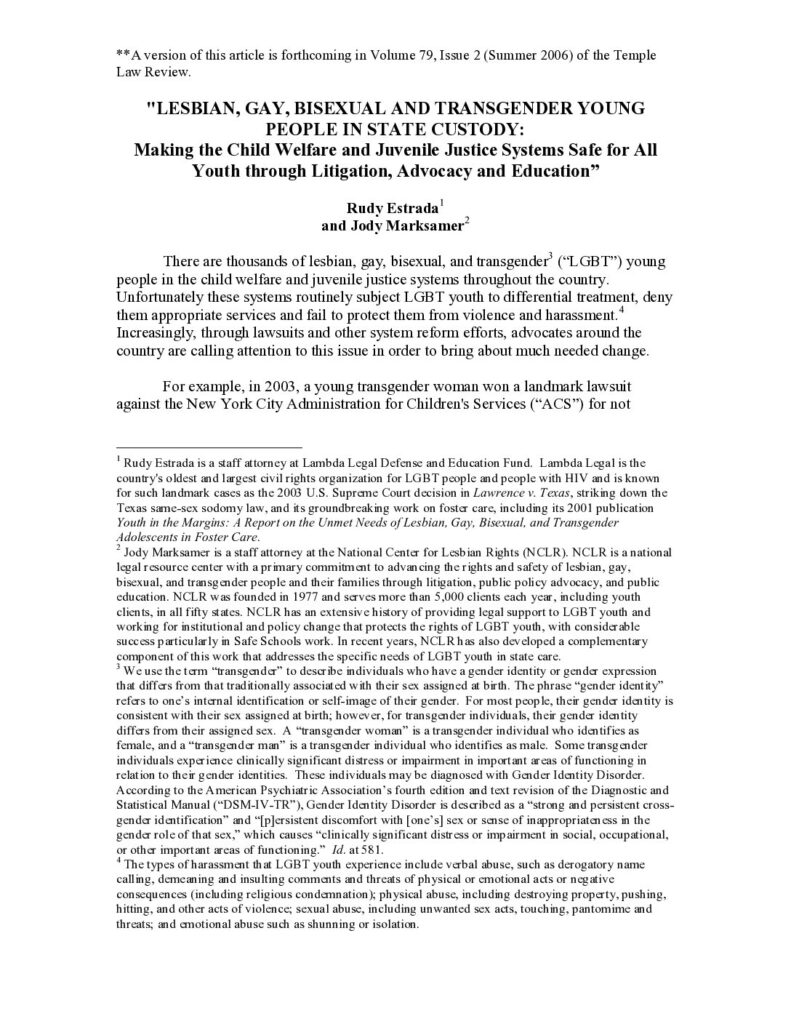
From the Conclusion: “For too long, LGBT young people in the child welfare and juvenile justice systems have been overlooked, ignored and mistreated. Because of the hard work of hundreds of advocates who have come together through coordinated national efforts, a cultural shift has begun. These advocates are creating effective nondiscrimination policies, best practices guidelines,…
- « Previous
- 1
- 2
- 3
- Next »
