
Public Health
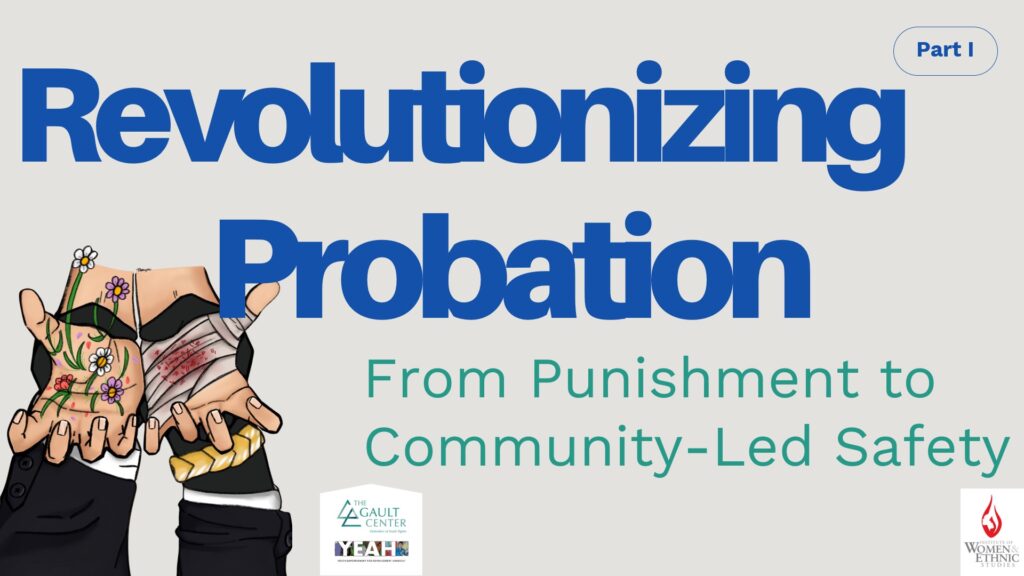
On March 26, 2026, the Gault Center & Youth Empowerment for Advancement Hangout (YEAH Philly) hosted a webinar on Revolutionizing Probation from Punishment to Community-Led Safety. This webinar focused on shifting narratives around juvenile probation—to challenge the dominant rhetoric that probation is an act of benevolence that keeps youth and communities safe and to bring…

On March 26, 2026, the Gault and Youth Empowerment for Advancement Hangout (YEAH Philly) co-hosted a webinar on Revolutionizing Probation from Punishment to Community-Led Safety. This resource includes PowerPoint presentations from the Gault Center covering the history and youth experiences on juvenile probation, YEAH Philly highlighting meaningful community-based alternatives, and the Institute of Women & Ethnic…
“This Article reconceptualizes preventive justice—the public safety paradigm that seeks to prevent harm before it occurs. Scholars have long documented how cities have advanced this paradigm through largely punitive measures, notably variants of broken windows policing, which posit that aggressive misdemeanor enforcement deters more serious crime. Yet in the aftermath of the 2020 George Floyd…

“For decades, in the summertime, America has confined certain of its youth in what are essentially open-air heat camps. In city after city, camp-form is established through the enactment of warm-weather juvenile curfews which keep the youth at home or in state-sponsored centers during summer nights and, increasingly, during days as well. Local governments justify…
“Today, America faces a health paradox: the nation’s largest jails are the nation’s largest psychiatric institutions. In a criminal justice system designed for punishment, solutions like mental health units or mental health courts try to address this contradiction. Yet, if mental illness is a health issue, and not a criminal issue, then increased investments in…

The Health and Reentry Project highlights promising Medicaid policy changes that promote continuity of care for young people returning to their communities following incarceration. The changes will support reentry for young people who are eligible for Medicaid or the Children’s Health Insurance Program by introducing them to services that would start 30 days before release…
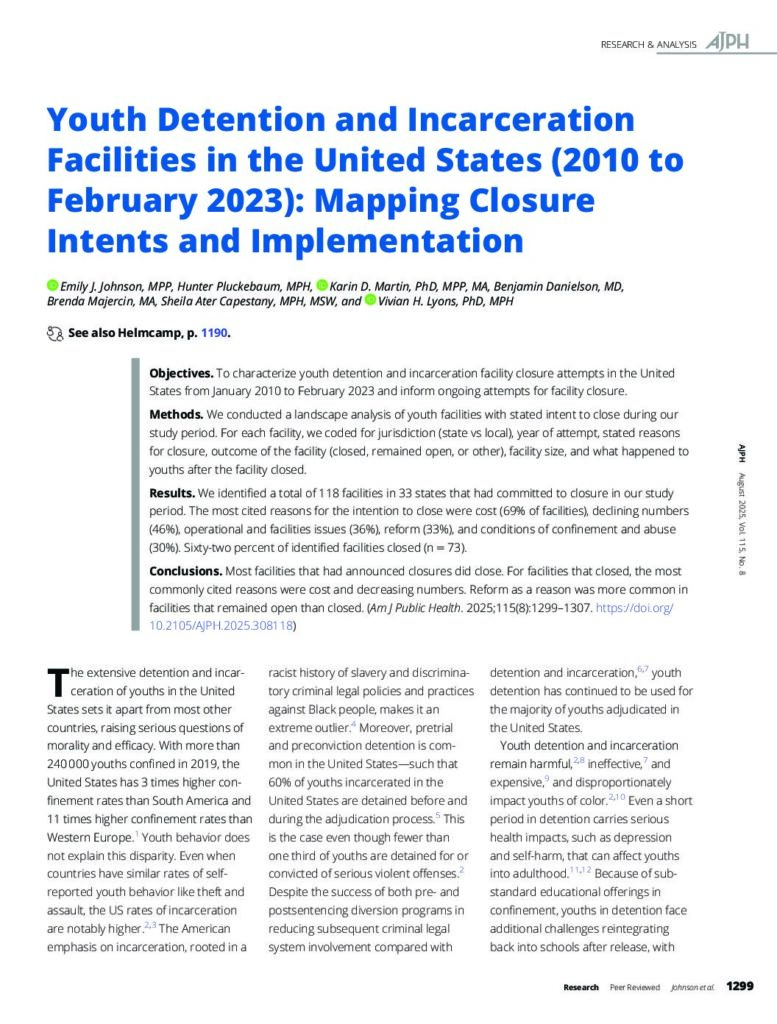
From the Discussion: “This study illuminates pathways for future research to explore facility closures. Such research should investigate the impact of specific drivers supporting completed closures of youth facilities, including the combination of stated reasons to appeal to different audiences. Notably, we only found 1 paper in our scoping review that explores the strategies used…

From the abstract: “The discipline of public health has begun to recognize the structural inequities of the carceral system as drivers of poor individual and population health. Thenumberofpeopleincarceratedandthelengthoftheirincarcerationdeterminethescopeandgravityoftheirexposureto these individual and public health effects. Plea bargains all but guarantee a period of incarceration, often for many years, because prosecutors have significant bargaining power against defendants…

From the introduction: “We know how to support transgender youth. Policies, practices, and care that accept and affirm young people’s gender identities can help transgender young people thrive. Research clearly shows that support and acceptance from parents, using young people’s chosen names, enacting inclusive policies and practices at schools and in the community, and providing…

From the introduction: “Sleep is a biological necessity. If camping on public property is banned across the board, those without access to shelter must unequivocally break the law. Houseless individuals have therefore challenged the constitutionality of anti-camping ordinances on several occasions, particularly under the Cruel and Unusual Punishment Clause of the Eighth Amendment. In a…

This report from National Institute for Criminal Justice Reform offers six principles of a positive youth justice system (‘PYJS’) including: 1) Minimize contact with the juvenile justice system, 2) partner with youth and families to develop and share ownership of case plans, 3) community-based organizations should take the lead, 4) build on youth assets and…



The Center for Justice Innovation conducted an exploratory, participatory action research study of 103 youth ages 15-24 who reported carry guns in a neighborhood of Brooklyn. The research evaluates why these youth carry guns and proposing a collaborative approach to public safety. From the report: “The increase in gun violence experienced in many U.S.…


From the introduction: “This report summarizes changes in youth incarceration following the onset of COVID-19, the key factors that drove and supported Utah’s shift away from incarceration, and the work that the jurisdiction still must do to sustain and build on these early successes.”

From the introduction: “The COVID-19 pandemic has laid bare the dangers of the juvenile legal system; this should make it harder to look away from the societal inequities that are exacerbated by youth incarceration. Indeed, the current moment, including the unprecedented nationwide protests in response to the murders of George Floyd and Breonna Taylor in…

