
Transfer or Bindover or Certification

On August 29, 2024, the Gault Center hosted a National Youth Defense Townhall focused on the role of youth defenders in transforming the juvenile legal system. The Townhall outlined a theory of change rooted in cultivating critical connections to harness our collective power to transform systems of harm and punishment. In attendance were nearly 200…

The Court of Appeals of Washington remanded a transfer case to the superior court and offered the following language in support. “Our Supreme Court has made clear that trial courts must be vigilant in addressing the threat of explicit or implicit racial bias that affects a defendant’s right to a fair trial. We hold that…

Florida routinely pushes Black children out of schools and into a legal system with well-documented harms. In recent years, the state has made significant investments in school law enforcement and self-proclaimed “tough love” youth legal system policies, purportedly in the name of public safety. However, these investments have yielded a system that disparately disciplines, arrests,…

The National Youth Justice Network released a report detailing legislative trends on youth rights from 2023. This report highlights key gains made by several states around juvenile court fines and fees, expungement, transfer, and youth interrogation among other issues, and flags several regressive legislative trends rooted in harmful narratives about young people. This overview of…

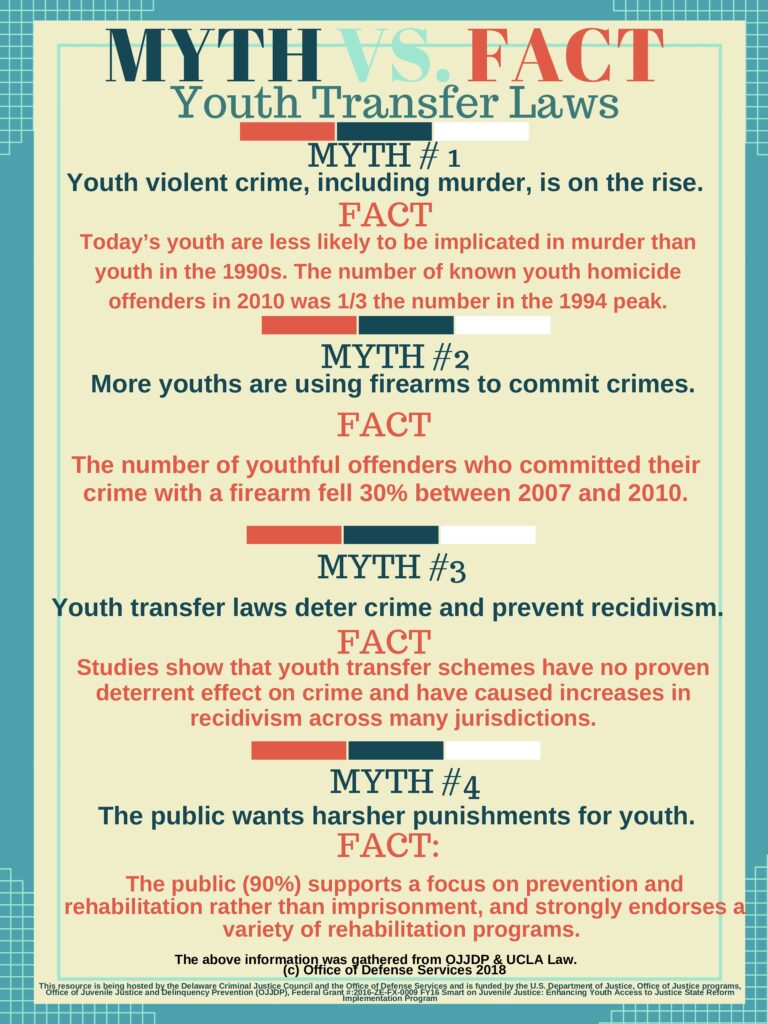
This one-page infographic from the Office of Juvenile Justice and Delinquency Prevention illustrates statistics on waiver from juvenile to criminal courts.

This research article explores the history of girls prosecuted as adults in courts across the United States. It explores the effects of childhood trauma and victimization on brain and physical development and the connection to involvement in the criminal legal system as children. The article describes the results of a survey of young women who…

In this session of our 2022 Racial Justice Training Series and Book Club, Prof. Kristin Henning and Mary Ann Scali were joined by Eric Campbell, formerly incarcerated founder of Some People Understand Differently (SPUD), Inc.; Carmen Daugherty, Deputy Executive Director of Advancement Project; and Kristen Rome, Co-Executive Director of Louisiana Center for Children’s Rights. This…

The COVID-19 pandemic, declared a public health emergency in the United States on March 13, 2020, had an impact on the policies, procedures, and data collection activities of juvenile courts relating to the referrals and processing of youth. Mitigation efforts such as stay-at-home orders and school closures impacted the volume and types of law-violating behavior…

This checklist can be used to assess the presence of constitutional violations throughout the course of a client’s case. Please refer to the National Youth Defense Systems Standards and their accompanying User Guide for litigation strategies to challenge potential constitutional violations noted in this checklist.

This User Guide provides advocates with a step-by-step outline of how to actualize the vision of the National Youth Defense System Standards to equip and invest in youth defense teams to fight for the liberation of all youth.The User Guide outlines constitutional rights detailed in the System Standards, provides a checklist to assess the presence…
Abstract: “This article demonstrates how advocates can leverage empirical literature regarding adultification bias to craft doctrinal interventions that recognize and remedy the disproportionately harsh treatment of Black youth in the juvenile and adult criminal legal system. Through case examples, all of which I litigated in the Civil Rights Clinic at Seattle University School of Law, I demonstrate how adultification…

This report details findings from the International Independent Expert Mechanism to Advance Racial Justice and Equality in Law Enforcement (The Expert Mechanism), who were appointed by the president of the Human Rights Council in 2021 with a mandate to examine the human rights of Black communities in the U.S. as they relate to police interaction…
From the Introduction of the Paper: “The U.S.’s failure to implement an internationally abiding federal law regulating juvenile justice has important implications on the treatment of incarcerated adolescent populations while incarcerated, rehabilitated, and reintegrated into society. This article will analyze the harmful and outdated legal frameworks and institutional structures of the U.S. juvenile justice systems.…

The Wren Collective (2023). This independent report by the Wren Collective examines youth defense appointment practices in Cuyahoga County, Ohio, and finds that juvenile court judges are routinely assigning private attorneys over public defenders to represent youth in juvenile court. Specifically, the public defender’s office was appointed to 25% of the juvenile delinquency cases in…

In January 2024, the National Center for Juvenile Justice released their annual report detailing data trends in juvenile courts across the country from 2005 to 2021. This report provides a national snapshot of various trends in delinquency cases, including key demographic patterns across age, gender, and race at various stages of case processing. Notably, in…

Outlines steps that states must take to comply with the minimum requirements of the U.S. Constitution to protect the rights of youth facing deprivations of liberty.



An annotated bibliography of research on transfer/waiver from Dr. Antoinette Kavanaugh Ph.D., ABPP including research on transfer and recividism, studies on how juvenile court judges weigh transfer factors, and demographic data and analysis on who is transferred to adult court.
