
Transfer or Bindover or Certification

From the introduction: “This brief is an accompaniment to a short video documentary, ‘Don’t Abandon Us: Addressing Youth, Crime, and Trauma.’ Both designed to help increase awareness among decision makers on how childhood trauma and adverse experiences can contribute to youth crime and future legal system involvement. In a moment of growing concern about crime,…

This bill amends CA WIC § 707(a) by requiring a court to find by clear and convincing evidence that a minor is not amenable to rehabilitation while under juvenile court jurisdiction and requiring that court’s order to include the reasons supporting a finding that a minor is not amenable to rehabilitation in the juvenile court. This bill…
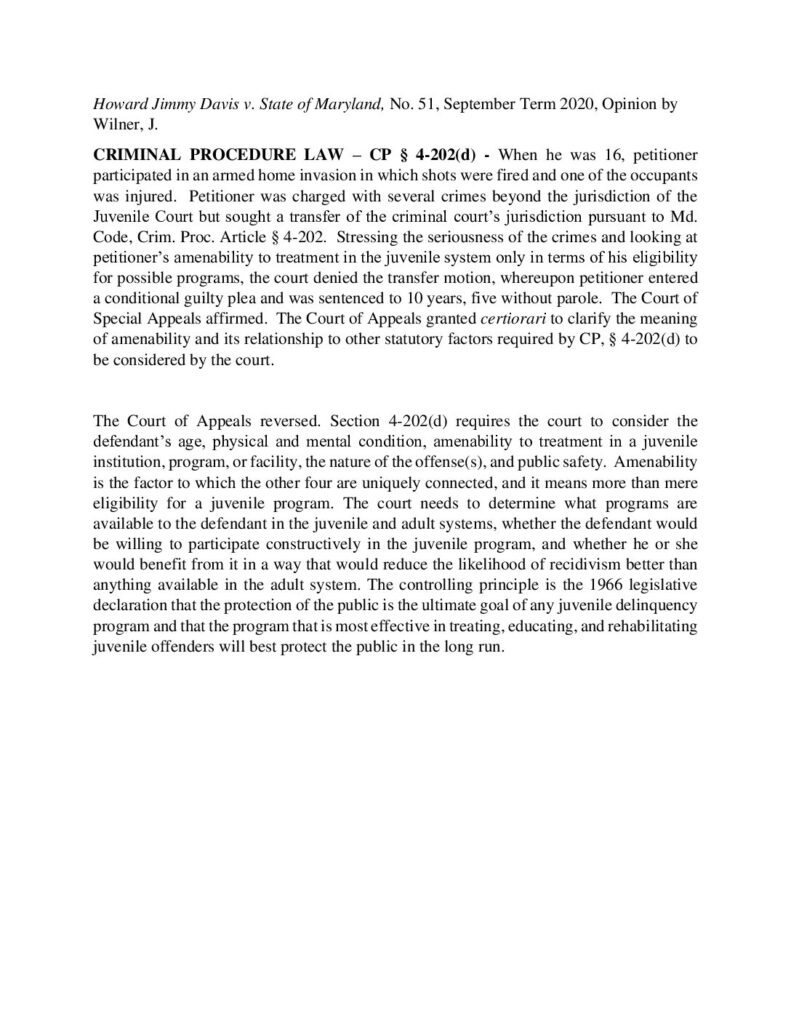
The Maryland Supreme Court held the Circuit Court did not properly consider Petitioner Howard Davis’ amenability to treatment in any institution, facility, or available programs under Md. Code Ann., Crim. Proc. § 4-202.2(b) and remanded the case, ordering the trial court to apply the principles and conclusions regarding amenability to treatment to Howard Davis’ Case. The court offered the following language in support: “To determine amenability to treatment, the court…

From the abstract: “The term wrongful conviction typically refers to the conviction or adjudication of individuals who are factually innocent. Decades of research has rightfully focused on uncovering contributing factors of convictions of factually innocent people to inform policy and practice. However, in this paper we expand our conceptualization of wrongful conviction. Specifically, we propose…


The Ohio Appellate Court vacated a youth’s convictions and transfer order and offered the following language in support. “Because the juvenile court (1) did not identify all of the factors it considered, i.e., the “other information factors” referenced at the amenability hearing, (2) did not identify or discuss the factual or evidentiary basis for its…


Click here to read the defense reply brief.

Click here to read the defense brief.


This brief highlights the United States Supreme Court’s most important language in landmark cases about young people’s rights. These quotes can be used to bolster the arguments and pleadings of juvenile defense attorneys and advocates as they defend youth caught in the legal system.

This article argues the Supreme Court’s recognition that children “are different than adults” creates a substantive due process right for every child to have an individualized assessment of their youthfulness at all critical junctures of a juvenile court proceeding, including transfer hearings. The article reviews transfer hearing statutes across the country and also analyzes fourteen…

The Kentucky Supreme Court found that competency attaches for young people at transfer hearings pursuant to the 6th and 14th Amendments of the U.S. Constitution as well as Section 11 of the Kentucky Constitution. The Court reasoned that because transfer hearings are critically important proceedings as identified in Kent, competence must be established before transfer…

This affidavit written by Legal Ethicist Abbe Smith outlines the ethical quandaries posed by Florida’s direct file transfer laws and calls into question the legality of such laws based on adolescent development research. The affidavit states in relevant part: “The prosecutorial practice of direct file plea-bargaining without defender/child knowledge of the case’s strengths and weaknesses…

On December 14, 2016, the U.S. Department of Justice entered into a settlement agreement with the St. Louis County Family Court to remedy constitutional violations. The settlement agreement covers policies and practices to ensure the due process and equal protection rights of all youth are upheld. This includes early appointment of youth defense counsel, prohibition…

The New Jersey Supreme Court held the state is required to disclose all discovery in its possession to the child before waiving the child to adult court and offered the following language in support. “N.H. moved for full discovery before the waiver hearing, and the trial court granted the request. The court analogized the filing…
