
Diversion

This brief describes how states currently treat two categories of young people: youth who commit status offenses—behaviors that are not categorized as crimes—and young children who do not have the developmental capacity to fully understand the crimes they are committing. Through a 50-state scan of policy and practice, we detail how states respond to these…

A new study by The Pew Charitable Trusts shows that young people assigned to probation after their first offense are more likely to be rearrested in the future, particularly for technical violations, than their peers diverted away from probation. The study, based on data provided by the Texas Juvenile Justice Department (TJJD) and analyzed by…

The COVID-19 pandemic, declared a public health emergency in the United States on March 13, 2020, had an impact on the policies, procedures, and data collection activities of juvenile courts relating to the referrals and processing of youth. Mitigation efforts such as stay-at-home orders and school closures impacted the volume and types of law-violating behavior…


This report highlights the importance of reducing the juvenile legal system’s reliance on incarceration by calling for systems reform that centers alternative-to-incarceration programs, adolescent development research, and evidence-based approaches. Highlighting successful state and local laws as well as policies and practices from across the country, the report offers examples of reforms like prohibiting the use…


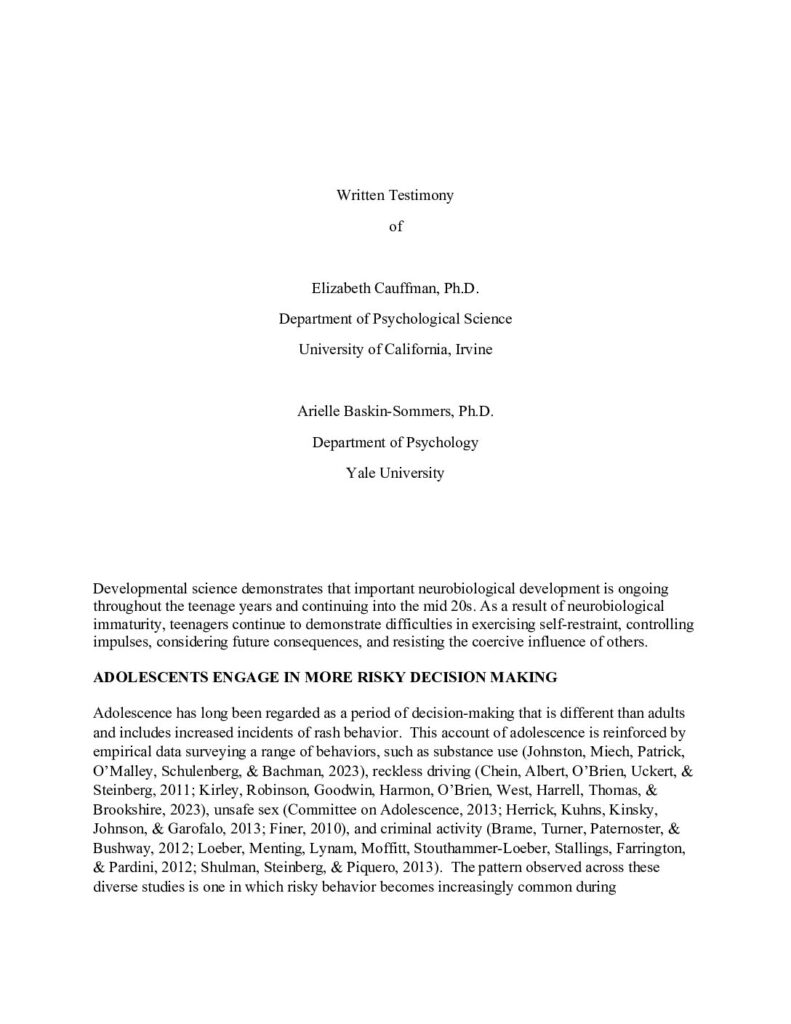
This written testimony from Elizabeth Cauffman, Ph.D. and Arielle Baskin-Sommers, Ph.D. discusses what developmental science says about the impact of brain development on adolescent risk taking, decision making, and susceptibility to social and peer influence as it relates to a young person’s culpability. The testimony also provides information on diversion and its impact on lower recidivism and improved public safety. Below is an excerpt from…

The Annie E. Casey Found. (2023). The Annie E. Casey Foundation undertook a three-year analysis from January 2020 to January 2023 of the effects of the Covid-19 pandemic on juvenile detention rates. The analysis concluded with three main findings: 1) Black youth were ten times more likely to be detained than white youth in 2023;…


From the introduction: “Imagine you’re a student with a disability that impacts how you interact with others and process situations. In an instant, that disability may be criminalized, and you could find yourself thrust into a juvenile justice system that offers little support and few education resources. This scenario is all too common. Thousands of…


- « Previous
- 1
- 2
- 3
- 4
- Next »
