
Diversion

From the introduction: “Preventing, reducing, and improving interactions between autistic individuals and the criminal justice system are urgent research and policy priorities. Research should guide evidence-based programs and policies that limit unnecessary interactions between autistic individuals and the criminal justice system and address documented high rates of victimization among autistic individuals. A diverse team of…

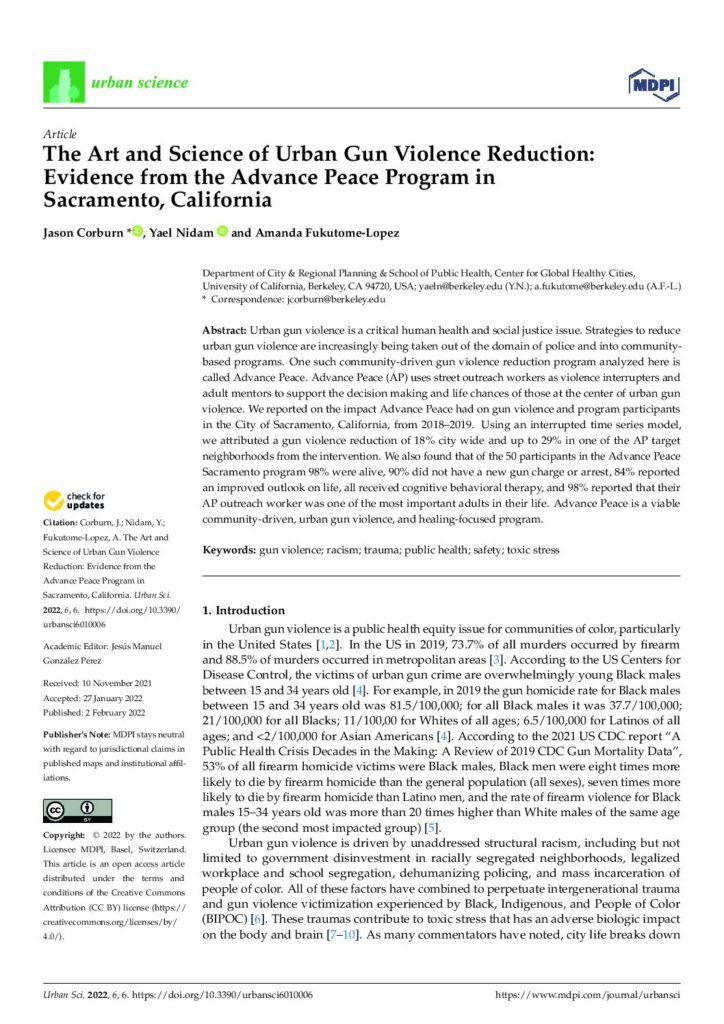
This article from Urban Science evaluates the success rate of the Advance Peace Sacramento gun crime reduction program and concludes that Advance Peace is a model for “urban public safety that combines inter-personal healing and community crime reduction. Abstract: “Urban gun violence is a critical human health and social justice issue. Strategies to reduce urban…
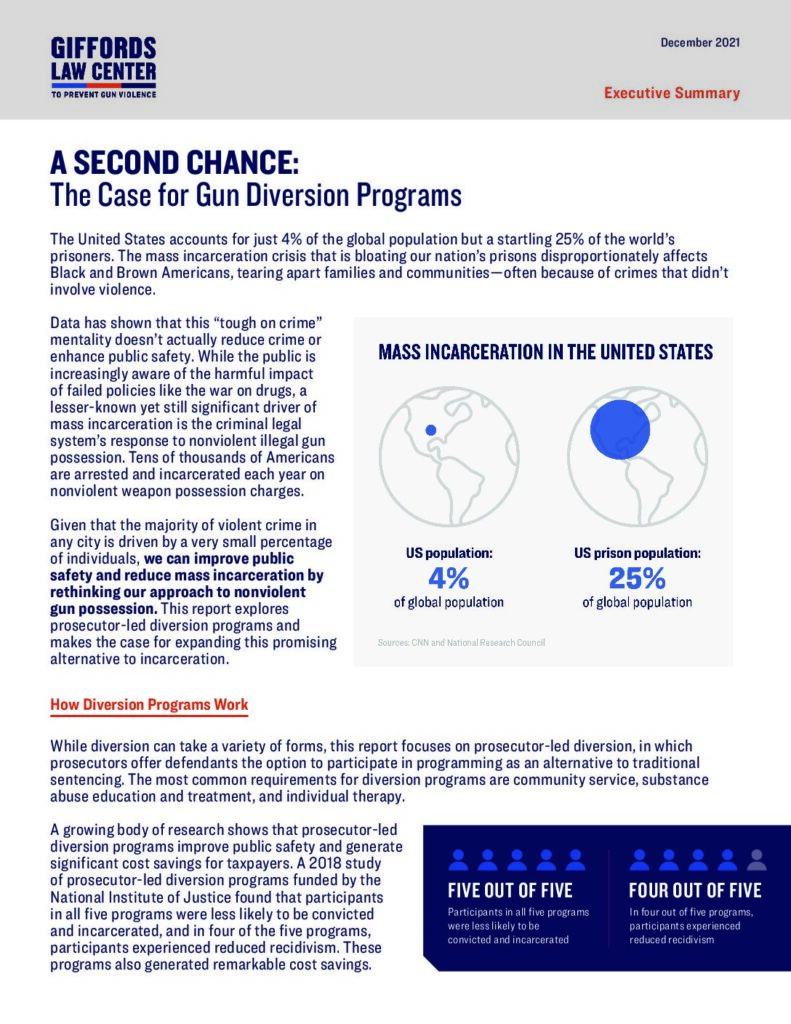
This executive summary from the Giffords Law Center examines the effectiveness of diversion programs for nonviolent gun possession, focusing on diversion programs in Brooklyn and Minneapolis as successful examples. From the resource: “The United States accounts for just 4% of the global population but a startling 25% of the world’s prisoners. The mass incarceration crisis…

This statement from the Youth Correctional Leaders for Justice outlines their support for states to adopt a minimum age of juvenile court jurisdiction at age fourteen. The statement includes ten reasons for raising the age of jurisdiction, highlighting that children under the age of fourteen are not yet developed enough to be criminally responsible for…
This study assesses the Philadelphia Police School Diversion Program, a pre-arrest diversion model which seeks to provide alternatives to the school-to-prison pipeline. From the conclusion: An evaluation of the Philadelphia Police School Diversion Program produced promising results, suggesting that such pre-arrest, school-based diversion opportunities can contribute to considerable reductions in school-based arrests without compromising school…

From the abstract: “The term wrongful conviction typically refers to the conviction or adjudication of individuals who are factually innocent. Decades of research has rightfully focused on uncovering contributing factors of convictions of factually innocent people to inform policy and practice. However, in this paper we expand our conceptualization of wrongful conviction. Specifically, we propose…

From the introduction: “This paper shares the story behind the successful launch of a specialized correctional unit for emerging adults by three of the people closest and most integral to the experience. It is offered as a guide for jurisdictions that are interested in developing similar programs. It is important to note that this report…

From the introduction: “This brief summarizes key findings from an unprecedented research study conducted by The Council of State Governments (CSG) Justice Center on the impact of juvenile justice system involvement—particularly probation— on school attendance in South Carolina and challenges jurisdictions across the country—as well as the broader field—to reconsider whether system involvement is the…
This issue brief from the Annie E. Casey Foundation highlights research on the impact of expanding diversion in the juvenile legal system. Overview from the brief: This brief presents the research case behind significantly expanding the use of diversion. The available evidence indicates that arresting young people and formally processing their cases in juvenile court…

Advocates in Maryland created a series of short policy briefs to educate community members about pressing issues. You can see the others in this series here under “Sample Legislative Advocacy Briefs” on the Policy Page of the Racial Justice Toolkit.

This comment replaces general comment No. 10 (2007) from the Committee on the Rights of the Child. The objectives and scope of this comment include the promotion of strategies for reducing harmful effects of childhood contact with the criminal legal system, protecting children’s rights at every stage of contact with the legal system, expanding non-custodial…

This report from Justice Policy Institute highlights lessons learned from states that have raised the age of juvenile court jurisdiction, including Connecticut, Illinois, Massachusetts, New Hampshire, Louisiana, Mississippi, and South Carolina. The report examines state fiscal data, juvenile legal system data, crime trends, confinement data, recidivism research, and case studies to draw conclusions about the…

On December 14, 2016, the U.S. Department of Justice entered into a settlement agreement with the St. Louis County Family Court to remedy constitutional violations. The settlement agreement covers policies and practices to ensure the due process and equal protection rights of all youth are upheld. This includes early appointment of youth defense counsel, prohibition…


On September 18, 2015, the U.S. Department of Justice entered into a settlement agreement with the state of Mississippi about their probation and diversion practices. The settlement agreement includes provisions on protecting a youth’s right against self-incrimination, requiring probation orders to be written in simple terms to prevent arbitrary and discriminatory enforcement, and ensuring the…

On July 31, 2015, the U.S. Department of Justice released its investigation findings into the St. Louis County Family Court, finding due process and equal protection violations. The findings include right to counsel violations by denying constitutionally adequate defense representation, privilege against self-incrimination violations by requiring a child to admit to allegations for diversion, inadequate…
A proposed settlement agreement between the United States and Lauderdale County in the State of Mississippi after an investigation of the substantive and procedural due process rights of youth who appear in Lauderdale County Youth Court. The Settle Agreement proposes several remedial measures the named parties must take including creating a probation process that complies…

From the introduction: “This report will describe, dissect, and draw lessons from Connecticut’s striking success in juvenile justice reform for other states and communities seeking similar progress. The first section details the timeline and dimensions of change in Connecticut’s juvenile justice system over the past two decades. In 1992, Connecticut routinely locked up hundreds of…

On October 24, 2012, the U.S. Department of Justice filed a complaint in the United States District Court, Southern District of Mississippi asserting that the City of Meridian, County of Lauderdale, and State of Mississippi are engaging in a “pattern or practice of unlawful conduct through which they routinely and systematically arrest and incarcerate children,…

On August 10, 2012, the U.S. Department of Justice released a findings report regarding their investigation of Lauderdale County Youth Court, Meridian Police Department, and Mississippi Division of Youth Services. The findings included the following violations: “(1) The City of Meridian Violates the Fourth Amendment by Arresting Children Without Assessing Probable Cause; (2) Lauderdale County…

From the introduction: “This research brief will summarize findings on what is known about substance abuse treatment as it relates to public safety and the use of incarceration. Along with conducting a brief literature review, the Justice Policy Institute (JPI) has compared state data on drug treatment admissions to incarceration rates. While no single solution…
