
Solitary Confinement
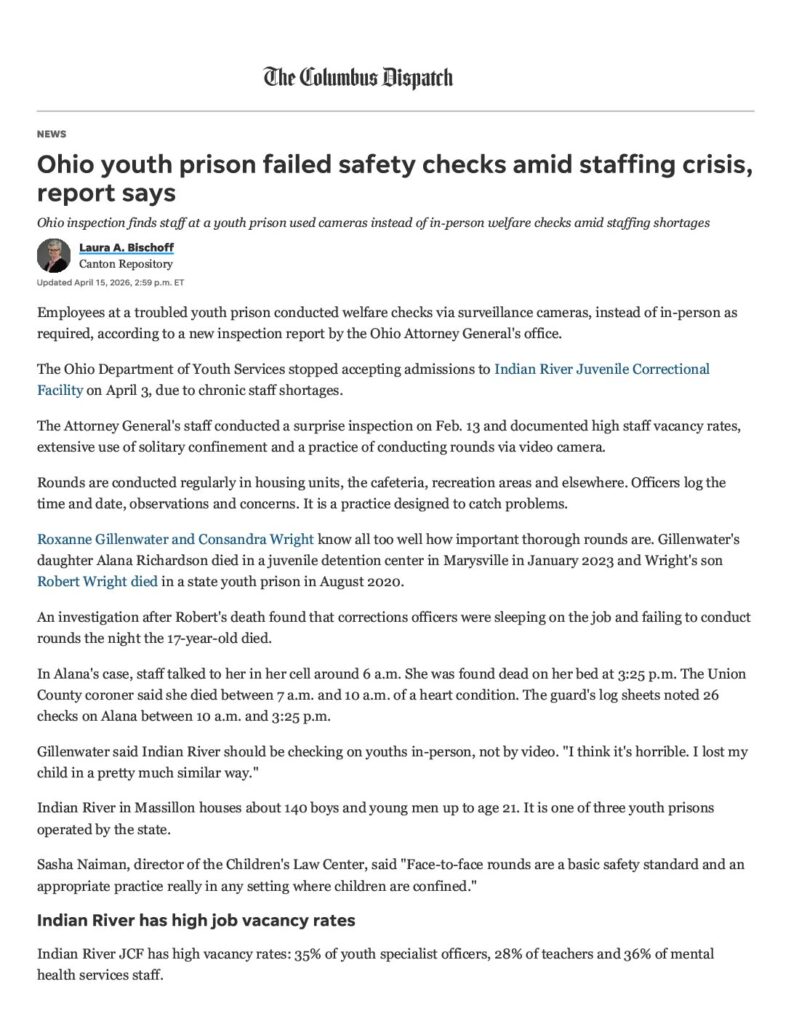
Executive Director Mary Ann Scali was interviewed by USA Today regarding conditions of confinement concerns at Ohio’s Indian River Juvenile Correctional Facility. Staffing shortages, extensive use of solitary confinement, and staff conducting rounds via video instead of in person are a just a few of the issues that have been reported by young people and…

“ American prisons are a black box: remote, austere, and cruel. Although basic demographic data about the people confined in prisons are common—that is, data on the number of people incarcerated, their age, or their race—there is little information available to the public regarding conditions of confinement. A natural response to this data deficit is…

Former Secretary of the Maryland Department of Juvenile Services, Vinny Schiraldi, wrote this op-ed, discussing President Trump’s deployment of National Guard troops in Washington D.C. and the District’s intentions to repeal lower the age for trying children as adults to 12 in the Youth Rehabilitation Act. The op-ed details Vinny’s reflections and observations during his…


The 7th Circuit Court of Appeals found that a liberty interest may exist for short periods of solitary confinement in deplorable conditions and offered the following language in support. “Jackson presented evidence showing that he was subjected to three months in appalling conditions of solitary confinement at Pontiac. Taking that evidence as true, Jackson had…


From the introduction: “This Article proffers human dignity as a novel conceptual vehicle for capturing and articulating solitary confinement’s harm to personhood. Starting from the Supreme Court’s edict that “the basic concept underlying the Eighth Amendment is nothing less than the dignity of man,” this Article employs a construct of dignity-as-integrity—or wholeness—of personhood. Using dignity-as-integrity…


This report challenges the notion that Georgia’s youth legal system is built to rehabilitate and suggests measures that protect the health and humanity of all the state’s children. First, this report will explore the myth of the “superpredator” and its impact on perceived Black youth criminality. Second, it will detail the state’s school-to-prison pipeline and…


This report details the results of the first-ever state-wide Adverse Childhood Experiences (ACEs) survey administered to people currently incarcerated for crimes they committed as children (under eighteen). The trauma measured from ACEs surveys include physical, sexual, and emotional abuse; physical and emotional neglect; separation from parents; mental illness or substance abuse in the home; parent…

This report from National Institute for Criminal Justice Reform offers six principles of a positive youth justice system (‘PYJS’) including: 1) Minimize contact with the juvenile justice system, 2) partner with youth and families to develop and share ownership of case plans, 3) community-based organizations should take the lead, 4) build on youth assets and…

On October 24, 2024, the U.S. Department of Justice filed a Statement of Interest in a federal class action lawsuit challenging conditions of confinement at the Mary Davis Detention Home in Galesburg, Illinois. The DOJ asserted, “The federal government, too, has repeatedly recognized that children are developmentally and constitutionally different than adults and that excessive…


Florida routinely pushes Black children out of schools and into a legal system with well-documented harms. In recent years, the state has made significant investments in school law enforcement and self-proclaimed “tough love” youth legal system policies, purportedly in the name of public safety. However, these investments have yielded a system that disparately disciplines, arrests,…

On August 29, 2024, the DOJ and the Connecticut Department of Correction entered into a settlement agreement with the following goals: “(1) ensure that children at Manson are not subjected to prolonged and improper isolation; (2) ensure that children at Manson receive appropriate mental health care; and (3) ensure that children at Manson receive appropriate…
Semi-annual report from the Colorado Division of Youth Services on use of seclusion and restraint in their youth facilities.


On May 15, 2024, the DOJ submitted a letter to Kentucky Governor Andy Beshear to notify the state of the commencement of a DOJ investigation into nine juvenile facilities operated by the Kentucky Department of Juvenile Justice (DJJ). The specific issues the DOJ outlined they would investigate include excessive use of chemical force, physical and…

In February 2024, the American Psychological Association released a resolution detailing evidence-based recommendations to limit and eventually eliminate the use of solitary confinement on youth. Key recommendations include prohibiting solitary confinement except under exigent circumstances, the duration of which generally should not exceed four hours, and prioritizing evidence-based strategies that promote positive youth development in…

No. 3:22-cv-00573 (M.D. La. 2023). The U.S. Department of Justice filed a statement of interest in a civil lawsuit addressing the constitutional rights of youth who had been adjudicated delinquent and transferred to the Louisiana State Penitentiary’s former death row building, known as Angola. In their statement, the United States asserted that youth are particularly…
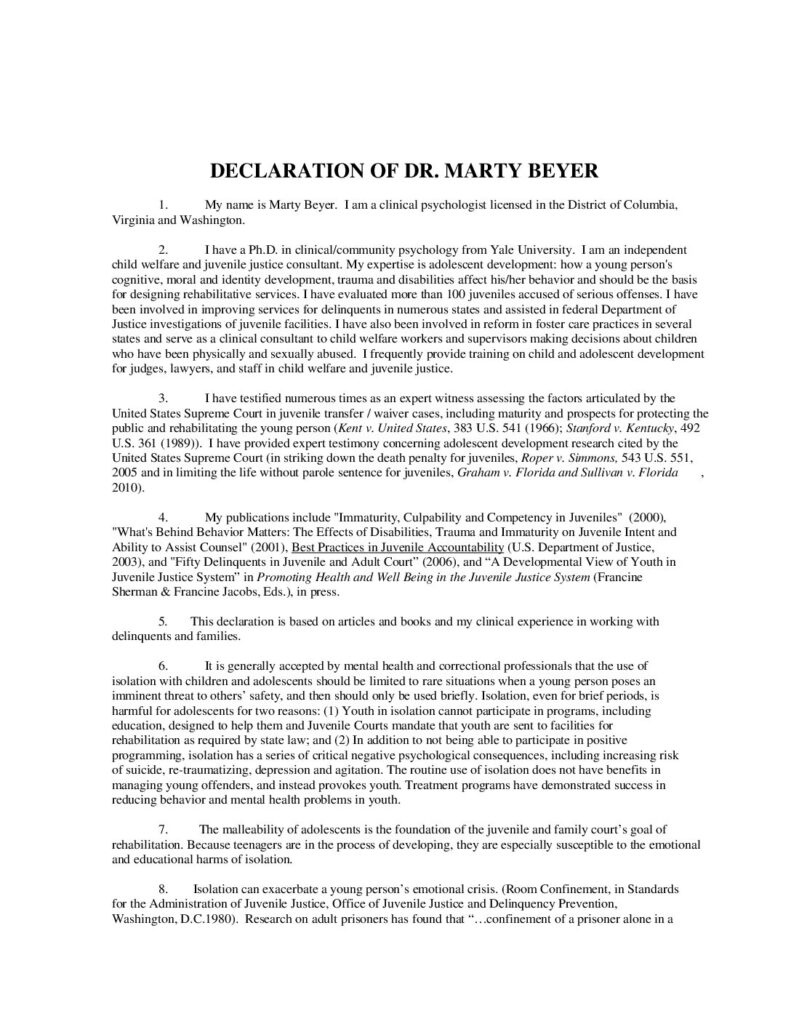
An expert declaration on the harms of the use of isolation on youth in juvenile correctional facilities.
