
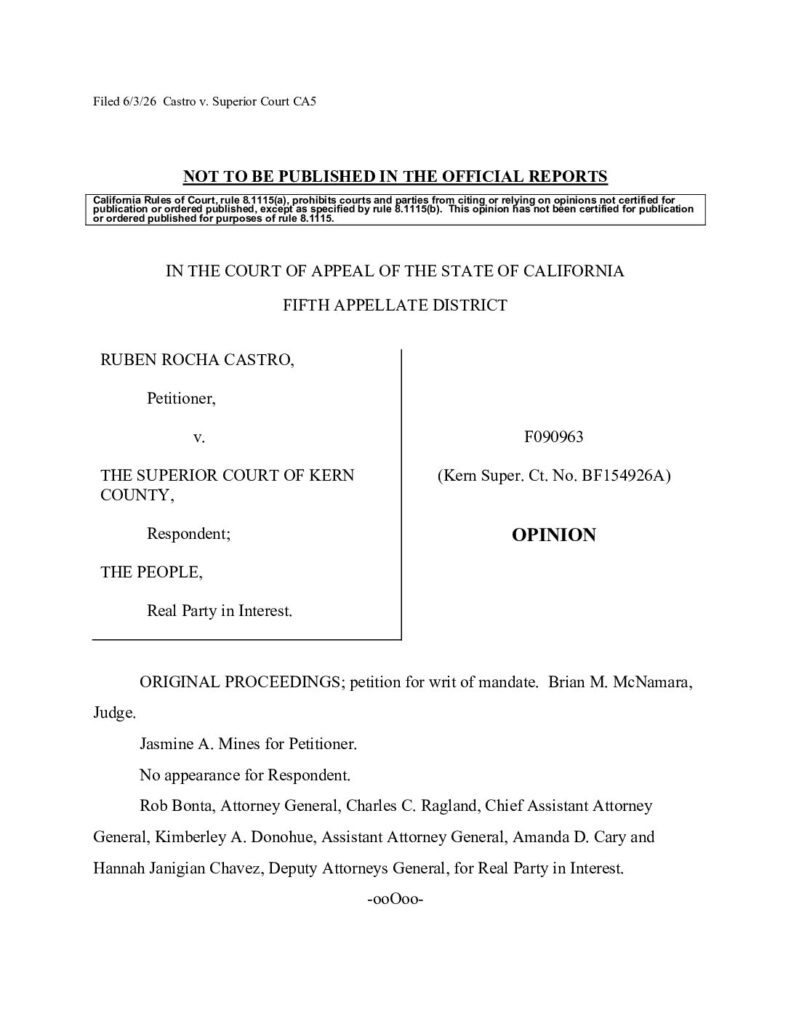
The California 5th District Court of Appeal held that the defense was entitled to discovery related to racial disparities in plea deals to voluntary manslaughter, finding that defense’s statistical evidence showing that Latine individuals in Kern County were more likely to be charged with murder and receive longer sentences than white individuals satisfied the “plausible…

The New Mexico Court of Appeals held that Malachi D. was reserved his right to appeal despite his plea, and the trial court erred in granting counsel’s request to dismiss the cause as the adjudication hearing was not heard in a timely manner. The court reasoned in part: “We believe that the judgment and disposition…

The Oregon Court of Appeals held that a plea colloquy has to affirmatively demonstrate that a young person understands the “consequences of an admission, including the maximum disposition associated with it”. The court stated in relevant part: “For an admission by a youth to be valid, the youth must be aware, in a manner consistent…
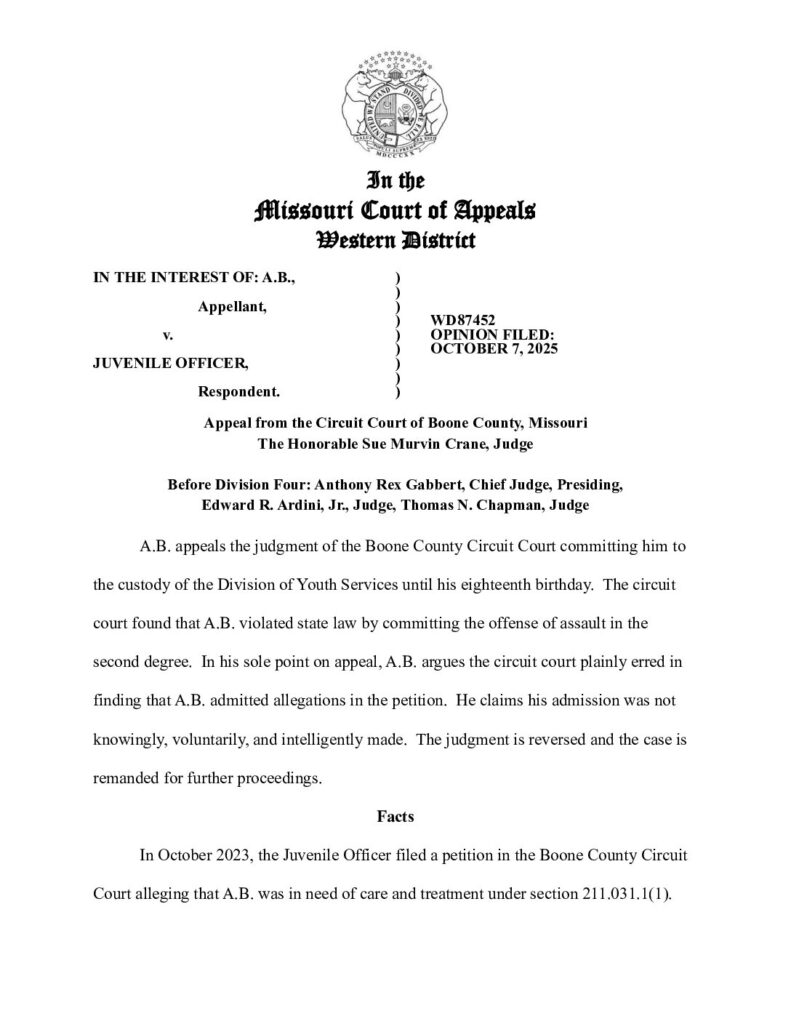
The Missouri Court of Appeals, Western District held that courts must ensure that a juvenile court admission is voluntarily, knowingly and intelligently made, and requires the court to establish a factual basis. The court stated in relevant part: ““A plea of guilty is constitutionally valid only to the extent it is ‘voluntary’ and ‘intelligent.’” Booker…

The Gault Center released an update on the state of youth defense in Kansas, which centers the perspectives and experiences of young people impacted by the juvenile legal system, through a collaborative effort with Progeny, a youth-adult partnership in Kansas, TerraLuna Collaborative, a research consulting group, and Mulberry Art Gallery, which focuses on supporting emerging…

This report highlights D.C. transfer laws and discusses the current U.S. Attorney’s argument that the District of Columbia should amend its law to transfer more young people to to adult court. The report compares D.C.’s transfer law to transfer laws across the country and highlights decades of research that has concluded transfer laws do not…

This resource offers a brief overview of how children are transferred or bound over to adult court in Ohio and discusses what is at stake in the case of State v. D.T., 2024-Ohio-4482 (Ohio Ct. App. 2024) pending before the Ohio Supreme Court. The Gault Center filed an amicus in this case here. Oral arguments were…

The 10th District Ohio Court of Appeals reversed a judgment of voluntary manslaughter because the youth’s admission was not knowingly, intelligently, and voluntarily entered and offered the following language in support. “Ultimately, “[t]he purpose of Juv.R. 29(D) is to ensure that any decision by the accused to forgo his or her constitutional right to a trial,…

From the abstract: “The discipline of public health has begun to recognize the structural inequities of the carceral system as drivers of poor individual and population health. Thenumberofpeopleincarceratedandthelengthoftheirincarcerationdeterminethescopeandgravityoftheirexposureto these individual and public health effects. Plea bargains all but guarantee a period of incarceration, often for many years, because prosecutors have significant bargaining power against defendants…


The Gault Center submitted an amicus brief in the Supreme Court of Ohio on a case involving a young person’s right to appeal a competence and transfer determination in juvenile court after entering a guilty plea in adult court. Outlining procedural justice arguments and the constitutional right to a competency and transfer hearing, the brief…
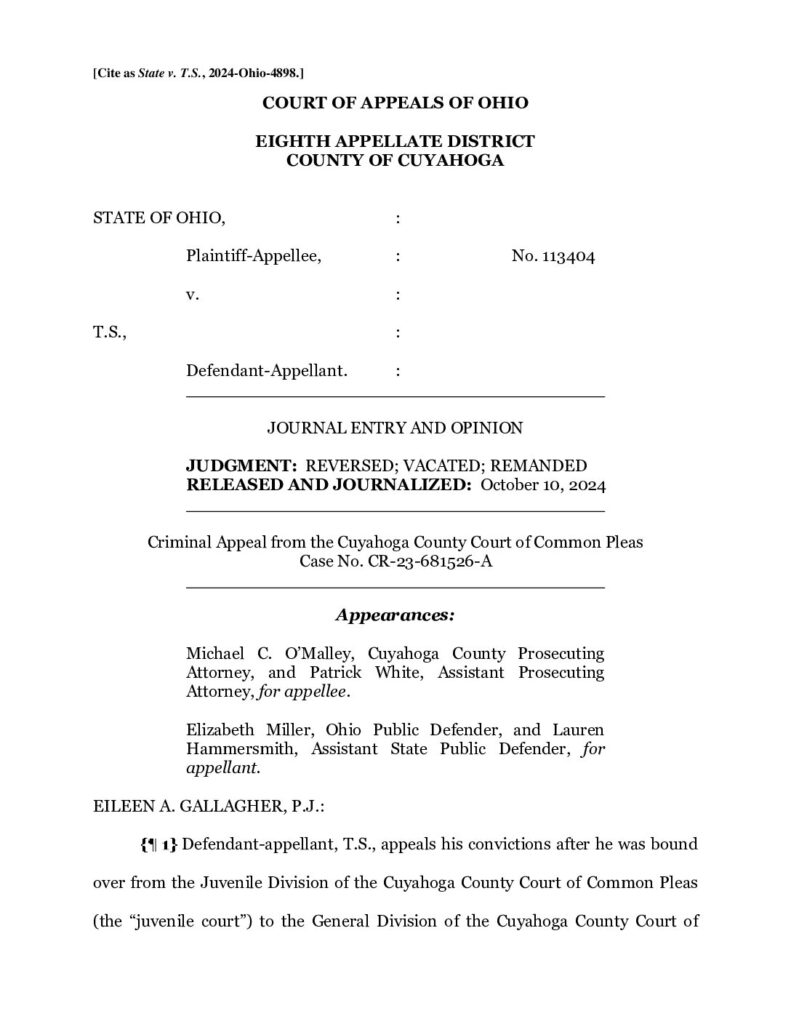
In State v. T.S., the Ohio Court of Appeals ruled the juvenile court abused its discretion when it transferred T.S.’s case to adult court pursuant to R.C. 2152.12(B) (Ohio’s discretionary transfer law). The court found the evidence presented in the transfer hearing, did not support a finding that T.S. was not amenable to rehabilitation within the juvenile system. The court offers the following language in support of its decision:: “Few,…


The New York Supreme Court Appellate Division reversed the guilty plea and conviction of Mr. Thorne after the court denied his motion to suppress, finding that the arresting officers lacked requisite reasonable suspicion to stop him. The Court, citing several inconsistencies in the radio description of the assailant compared to Mr. Thorne, offered the following language in support: “The officers did not have reasonable…
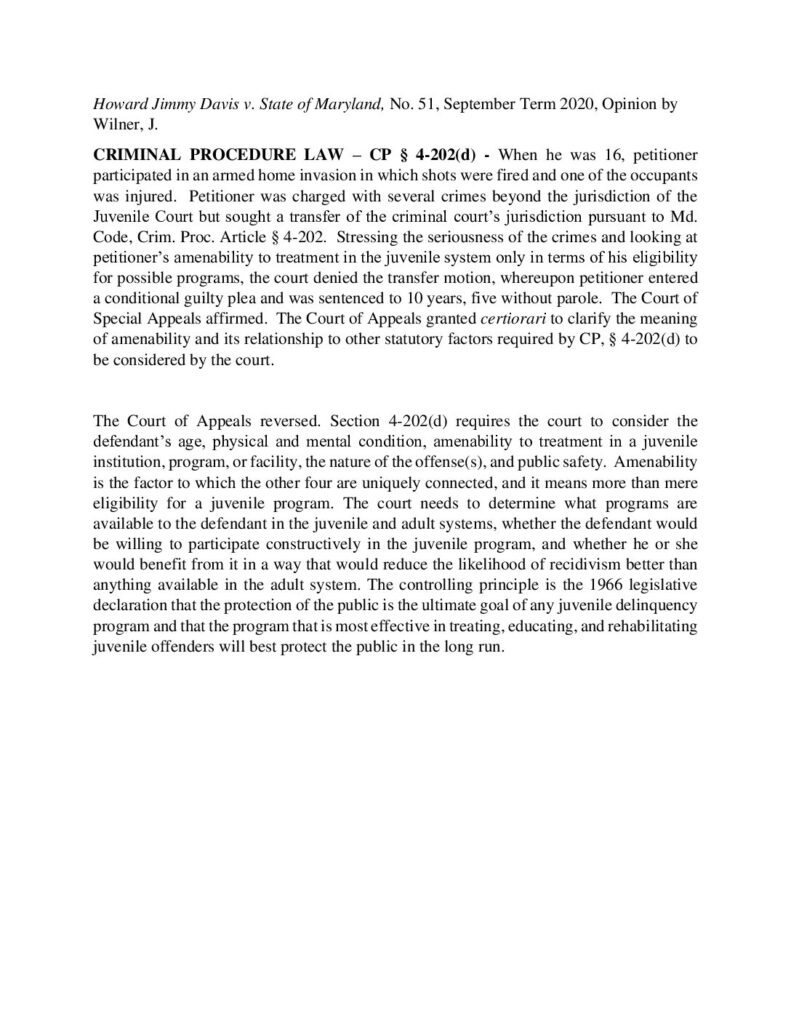
The Maryland Supreme Court held the Circuit Court did not properly consider Petitioner Howard Davis’ amenability to treatment in any institution, facility, or available programs under Md. Code Ann., Crim. Proc. § 4-202.2(b) and remanded the case, ordering the trial court to apply the principles and conclusions regarding amenability to treatment to Howard Davis’ Case. The court offered the following language in support: “To determine amenability to treatment, the court…

The Ohio Appellate Court vacated a youth’s convictions and transfer order and offered the following language in support. “Because the juvenile court (1) did not identify all of the factors it considered, i.e., the “other information factors” referenced at the amenability hearing, (2) did not identify or discuss the factual or evidentiary basis for its…

This affidavit written by Legal Ethicist Abbe Smith outlines the ethical quandaries posed by Florida’s direct file transfer laws and calls into question the legality of such laws based on adolescent development research. The affidavit states in relevant part: “The prosecutorial practice of direct file plea-bargaining without defender/child knowledge of the case’s strengths and weaknesses…

On December 14, 2016, the U.S. Department of Justice entered into a settlement agreement with the St. Louis County Family Court to remedy constitutional violations. The settlement agreement covers policies and practices to ensure the due process and equal protection rights of all youth are upheld. This includes early appointment of youth defense counsel, prohibition…

On July 31, 2015, the U.S. Department of Justice released its investigation findings into the St. Louis County Family Court, finding due process and equal protection violations. The findings include right to counsel violations by denying constitutionally adequate defense representation, privilege against self-incrimination violations by requiring a child to admit to allegations for diversion, inadequate…
The Campaign for the Fair Sentencing of Youth issued Trial Defense Guidelines for representing youth facing a possible life sentence. “The objective of these guidelines is to set forth a national standard of practice to ensure zealous, constitutionally effective representation for all juveniles facing a possible life sentence (“juvenile life”) consistent with the United States…

On December 17, 2012, the U.S. Department of Justice entered into a settlement agreement with Shelby County and the Juvenile Court of Memphis and Shelby County in Tennessee following their investigation into the juvenile court system. The settlement agreement includes remedial measures to align the following practices with the U.S. Constitution: probable cause determinations, notice…

Expert Affidavit of Susan L. Burrell on Standards of Competence in the Legal Representation of Youth
Expert Affidavit of Susan L. Burrell for a young person’s case in Colorado claiming ineffective assistance of counsel. The claims included a failure to fulfill basic duties to the client, failure to investigate, failure to retain expert witnesses, and a failure to assure that a plea was voluntary, knowing and intelligent.

On December 17, 2012, the U.S. Department of Justice entered into a settlement agreement with Shelby County and the Juvenile Court of Memphis and Shelby County in Tennessee following their investigation into the juvenile court system. The settlement agreement includes remedial measures to align the following practices with the U.S. Constitution: probable cause determinations, notice…
