
Transfer or Bindover or Certification

This amicus brief by Juvenile Law Center, The Gault Center, and others argues Ohio’s mandatory bindover statute violates the Due Process protections guaranteed by the 14th Amendment of the U.S. Constitution as the mandatory scheme does not allow for individualized sentencing and recognition of the unique characteristics of youth. Further, amici argue individualized transfer proceedings…

This amici brief by Juvenile Law Center, Loyola Civitas Childlaw Clinic, and others argues automatic prosecution and mandatory sentencing of young people charged with felony murder is unconstitutional in light of recent Supreme Court case law as Illinois law does not allow for individual sentencing based on maturity and culpability. Furthemore, the brief argues the…
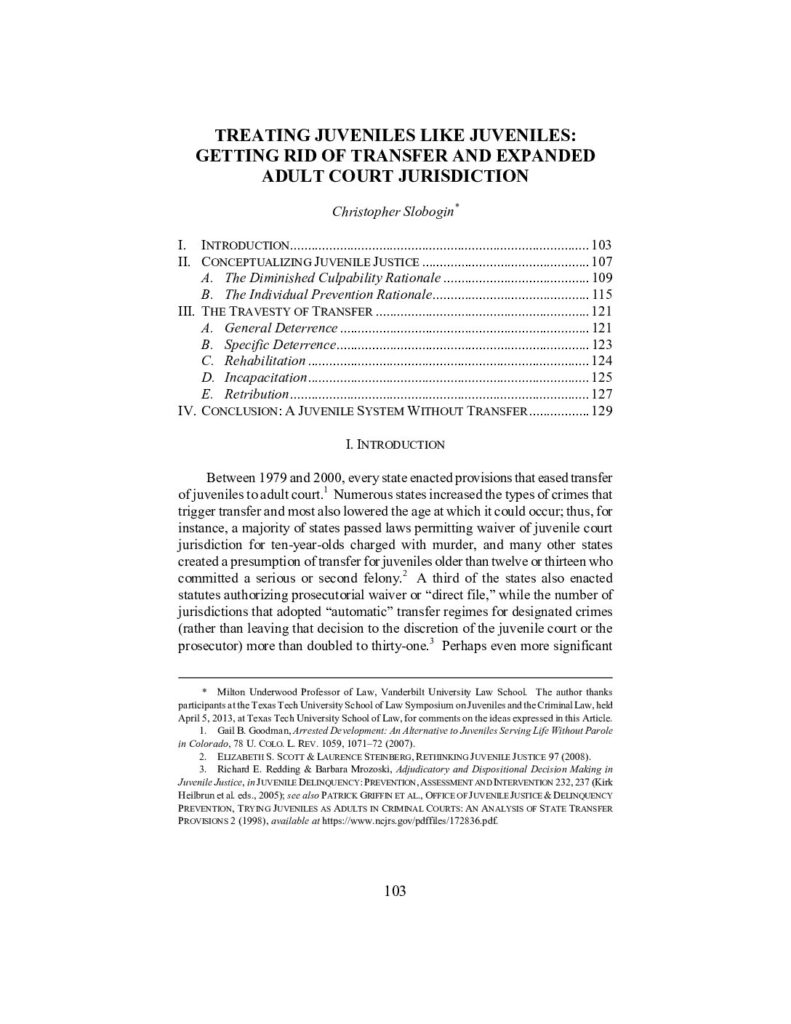
From the Abstract: The number of juveniles transferred to adult court has skyrocketed in the past two decades and has only recently begun to level off. This symposium article argues that, because it wastes resources, damages juveniles, and decreases public safety, transfer should be abolished. It also argues that the diminished culpability rationale that has…

This amicus brief prepared by Children’s Law Center, Inc., the Office of the Ohio Public Defender, The Gault Center, and others argues that due process and fundamental fairness, pursuant to the 5th Amendment, the 14th Amendment and Ohio law, require the state to provide full discovery to a young person prior to a probable cause…

The Kentucky Court of Appeals vacated a young person’s conviction in adult court based on ineffective assistance of counsel during the transfer hearing. Noting transfer as a critical stage in the proceeding and defense counsel’s failure to present any lay or expert witnesses and effectively cross-examine the prosecution’s witnesses, the court concluded that the transfer…

From the introduction: “This report will describe, dissect, and draw lessons from Connecticut’s striking success in juvenile justice reform for other states and communities seeking similar progress. The first section details the timeline and dimensions of change in Connecticut’s juvenile justice system over the past two decades. In 1992, Connecticut routinely locked up hundreds of…
From the Abstract: The juvenile waiver system is flawed as it arbitrarily subjects minors to adult criminal proceedings, disregarding their potential for rehabilitation and violating their due process rights. The system must be reformed to ensure fair, individualized assessments and protect [children’s] rights.

On December 17, 2012, the U.S. Department of Justice entered into a settlement agreement with Shelby County and the Juvenile Court of Memphis and Shelby County in Tennessee following their investigation into the juvenile court system. The settlement agreement includes remedial measures to align the following practices with the U.S. Constitution: probable cause determinations, notice…

The Court of Appeals of Indiana found the juvenile court abused its discretion when it denied a 12-year-old’s continuance of his waiver hearing after his attorney only had four business days to investigate and prepare for the hearing. The court reversed the child’s conviction in adult court and remanded the proceeding to juvenile court offering…
This amicus brief by The Juvenile Law Center and The Gault Center wrote the amicus, urging the Supreme Court to Grant Certiorari in the case of Bunch v. Bobby. This brief argues that juvenile life without parole sentences are unconstitutional for non-homicide offenses as articulated in Graham must be applied to sentences that are the…

On December 17, 2012, the U.S. Department of Justice entered into a settlement agreement with Shelby County and the Juvenile Court of Memphis and Shelby County in Tennessee following their investigation into the juvenile court system. The settlement agreement includes remedial measures to align the following practices with the U.S. Constitution: probable cause determinations, notice…

This amici brief prepared by the Juvenile Law Center et al. highlights the particular characteristics of adolescent development and youth that make juvenile life without parole sentences unconstitutional and in violation of the 8th Amendment to the U.S. Constitution. The brief addresses youth’s culpability, potential for change, and risk taking behavior compared to adults as…

This amicus brief by Juvenile Law Center, Campaign for Youth Justice, and The Gault Center argues the transfer hearing in the state juvenile court deprived the young person of due process when the judge only considered the intentional murder charge, when they were ultimately convicted on the lesser offense of felony murder and second degree…

This amicus brief by Juvenile Law Center and The Gault Center argues Illinois automatic transfer law does not comply with recent research and findings on adolescent development as recognized by the Supreme Court jurisprudence in Roper and Graham. Further, amici argue the state’s automatic transfer statute violates the proportionality clause of Article I, Section 11…

The U.S. Supreme Court held juvenile life without parole for non-homicide offenses violates the 8th Amendment and offered the following language in support. “Roper established that because juveniles have lessened culpability they are less deserving of the most severe punishments. 543 U.S., at 569, 125 S. Ct. 1183, 161 L. Ed. 2d 1. As compared…
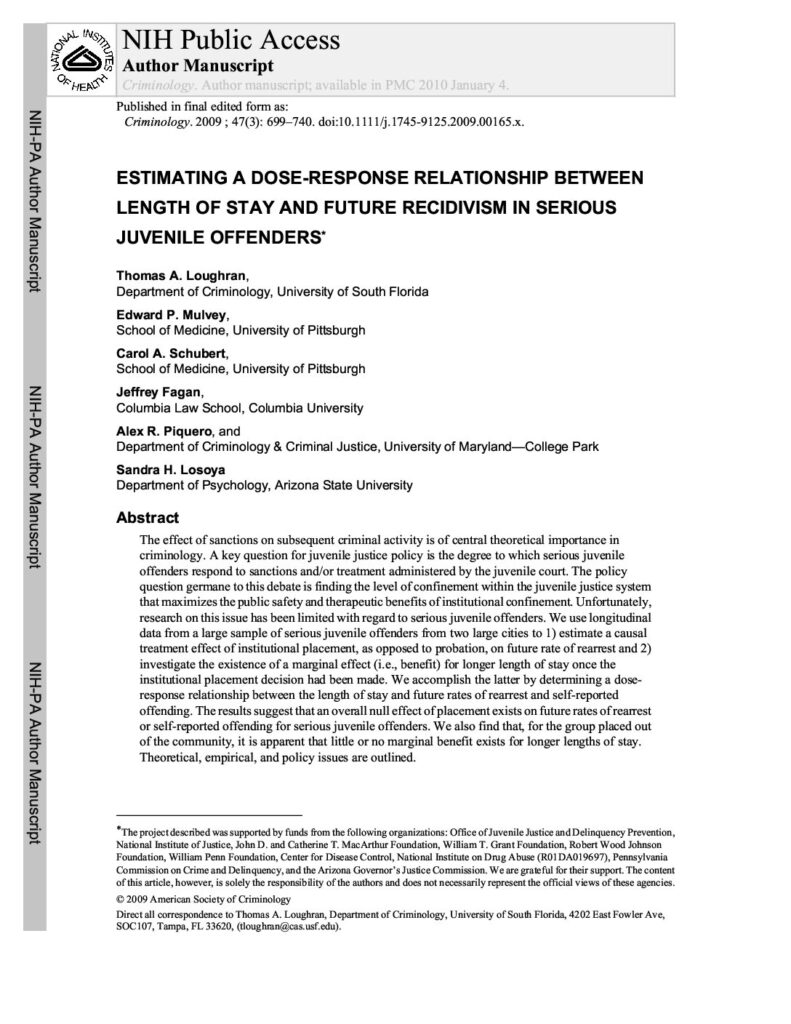
From the Abstract: “The effect of sanctions on subsequent criminal activity is of central theoretical importance in criminology. A key question for juvenile justice policy is the degree to which serious juvenile offenders respond to sanctions and/or treatment administered by the juvenile court. The policy question germane to this debate is finding the level of…

This amicus brief by The Juvenile Law Center, The Gault Center, and others highlights the unique developmental status of youth, relevant social science research, and Supreme Court Jurisprudence, that make a life without parole sentence for non-homicide crimes unconstitutional in violation of the 8th Amendment of the U.S. Constitution. As stated in their brief: “The…

This amicus brief by The Gault Center and others argues Nevada’s certification statute violates a child’s right to effective assistance of counsel as it interferes with counsel’s ability to plan and participate in the adversarial fact-finding process and it fails to measure up to essentials of due process and fair treatment. Furthermore, amici argue this…
This report from the Centers for Disease Control and Prevention provides a review of the effectiveness of laws and policies that facilitate the transfer of youth to adult court and ultimately, recommends against transfer to prevent or reduce violence. From the Summary: “The independent, nonfederal Task Force on Community Preventive Services (Task Force), which directs…
This article evaluates whether there is a relative deterrent effect of transfer laws on the overall crime rate among youth. From the summary: In recent years, the juvenile justice system has undergone a “get tough” transformation. One component of the system which has experienced substantial alteration is the mechanism by which states allow for the…

From the introduction: “This brief tells the story of how the four Models for Change states—Pennsylvania, Illinois, Louisiana, and Washington—are already moving to reform and reshape their own state juvenile justice systems. These states have demonstrated strong leadership in juvenile justice policy, value collaboration and engagement, and because of their efforts, have changed the political…


From the introduction: “This policy brief will review the work done in one jurisdiction that has succeeded in reducing the number of minority youth detained pre-trial, summarize the lessons learned from innovations in Multnomah County, Oregon, and highlight their national significance. While the more general nationwide picture on reducing racial disparity in the juvenile justice…
From the Introduction: This Article argues that empirical research and the stories of child-inmates undermine the justification for Florida’s policy of incarcerating children in adult prisons. Florida’s policy is not based on facts but on empty rhetoric, such as “Tough Love.” This Article will critique three arguments for incarcerating children in Florida prisons: (1) that…
