


From the introduction: “This manual contains three different sections that address: (1) your rights when dealing with the U.S. Immigration and Customs Enforcement (ICE) and how to get prepared; (2) steps to take and information to know when supporting an individual or family after an ICE raid, and (3) strategies for organization around an individual…
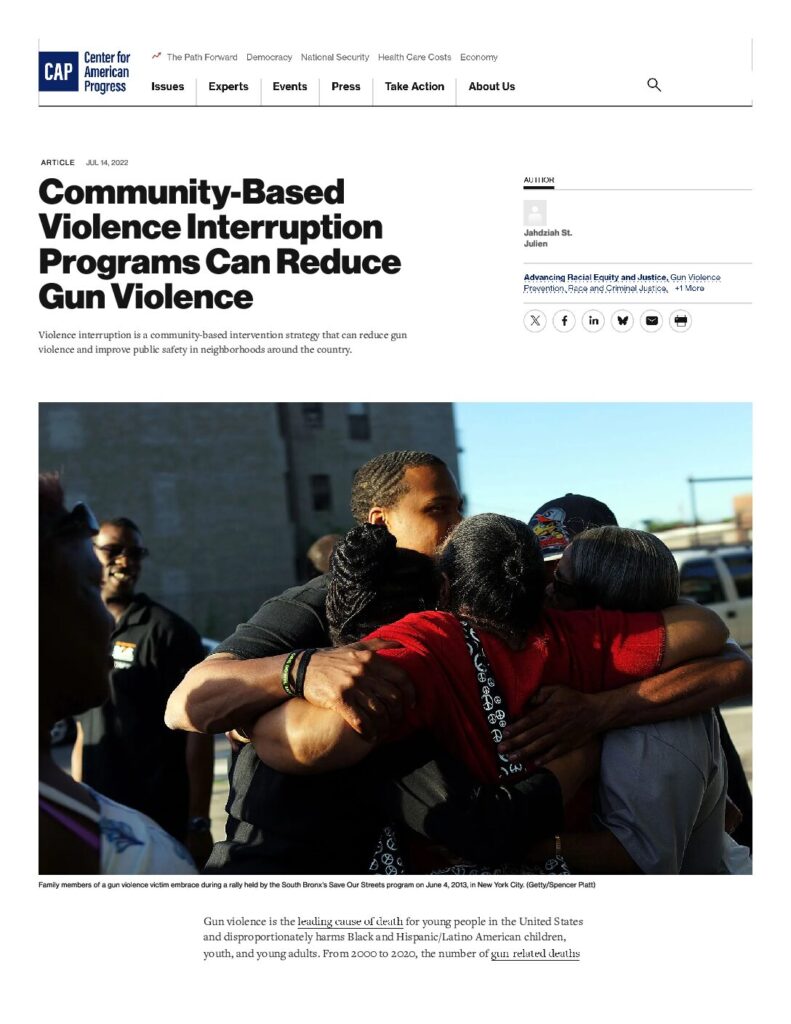
This policy analysis and literature review examines how community-based violence intervention (CVI) programs serve as an evidence-based alternative to punitive, carceral responses to gun violence in communities disproportionately impacted by firearm deaths. It draws on CDC mortality data, program evaluation reports, and organizational documentation from three violence interrupter programs: South Bronx’s Save Our Streets (SOS),…

The New York Supreme Court Appellate Division reversed the guilty plea and conviction of Mr. Thorne after the court denied his motion to suppress, finding that the arresting officers lacked requisite reasonable suspicion to stop him. The Court, citing several inconsistencies in the radio description of the assailant compared to Mr. Thorne, offered the following language in support: “The officers did not have reasonable…


This report from The Sentencing Project highlights “raise the age” legislative successes across the country, underscoring that the use of youth confinement is not a necessary result of these legislative shifts. For the nine states that implemented raise the age legislation, only New York, North Carolina, and Louisiana added juvenile facilities that are still operating,…
This issue brief from the Annie E. Casey Foundation highlights research on the impact of expanding diversion in the juvenile legal system. Overview from the brief: This brief presents the research case behind significantly expanding the use of diversion. The available evidence indicates that arresting young people and formally processing their cases in juvenile court…

This pleading addrresses school district illegally strip searching 12-year-old Black and Latina students.

From the executive summary: ‘This comprehensive study of 804 New York City public middle and high schools sought to isolate the independent impacts of suspension, as well as to disentangle the effects, if any, of student, school, and neighborhood characteristics. Conversely, the study also explored the relationship of restorative justice and other positive practices to…
The Columbia University Justice Lab released a report spotlighting New York City’s Close to Home initiative, an effort that reduced the rate of youth sent to state-operated prisons in New York City. “This case study describes the development of the Close to Home (C2H) initiative, beginning with a review of what the system looked like…


The U.S. Department of Justice filed a Statement of Interest in a federal class action lawsuit challenging the use of solitary confinement for 16- and 17-year-old youth in custody, including youth with disabilities. Calling for the federal district court to consider Supreme Court jurisprudence and growing scientific research on adolescent development, the DOJ asserts, “Juveniles…

On January 3, 2017, the DOJ filed a Statement of Interest in a case involving the use of solitary confinement for 16 and 17 year olds in the Onondaga County Justice Center in New York. This brief outlines the harms of solitary confinement as applied to young people in light of their brain development and…

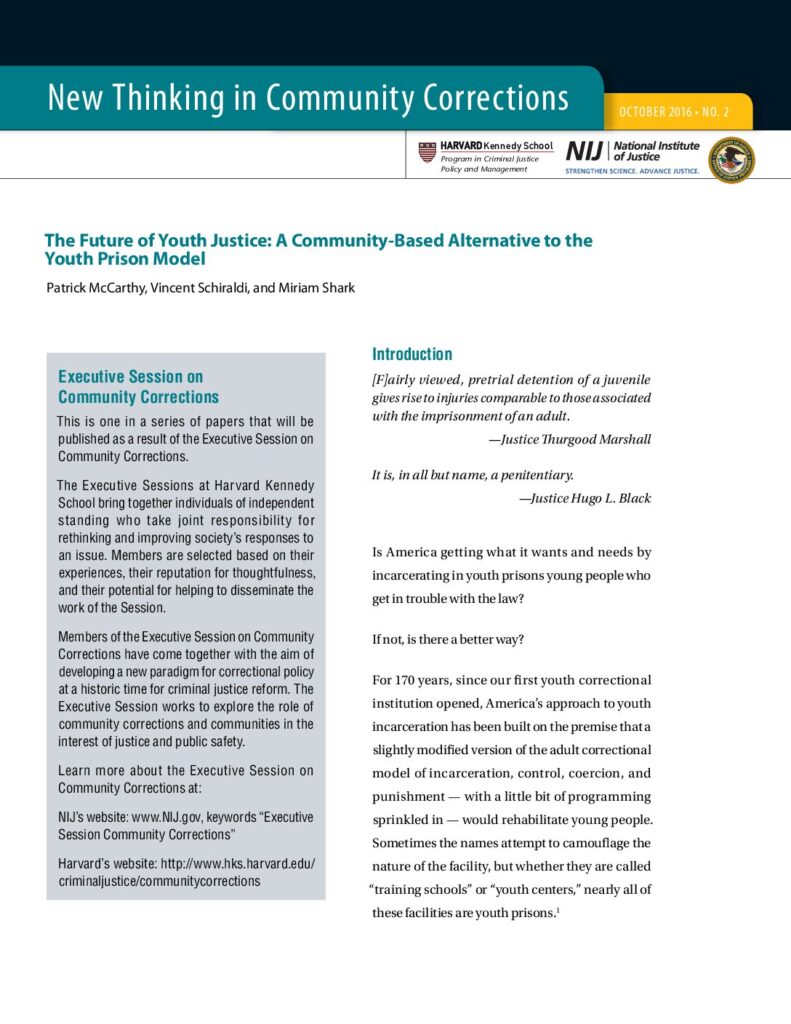
This paper from the Executive Session on Community Corrections at the Harvard Kennedy School examines the history of youth incarceration and discusses how the inherently flawed model of youth prisons demands systemic reforms, including closure of youth prisons, to actualize safer communities, and positive youth outcomes. From the introduction: “For 170 years, since our first youth correctional institution opened, America’s approach…

The New York Supreme Court Appellate Division reversed the judgement and conviction, vacated the plea, and granted the motion to suppress all evidence after finding the police lacked an objective, credible reason to justify an initial approach and request for information. The court, citing a lack of evidence to support the police encounter, offered the following language in support: “In evaluating police conduct, a court “must determine whether the action taken was justified…

This article summarizes a study conducted by Yale Law School, Columbia Law School and Mailman School of Public Health at Columbia University, examining the influence of street stops by police on the legal socialization of adolescents and emerging adults ages 18-26 in New York City. The study showed an association between the number of police…

A practice guide for youth defenders in delinquency cases when litigating suppression issues. This guide covers all aspects of litigating a suppression motion: from drafting the motion, securing witnesses, evidentiary considerations, appellate preservation, and procedural aspects of the suppression hearing that may arise at the suppression hearing, during trial. and on appeal.

On August 14, 2013, the U.S. Department of Justice filed a Statement of Interest in a federal class action lawsuit on the constructive denial of counsel in criminal proceedings within five counties in New York. The DOJ asserted, “The provision of defense services is a multifaceted and complicated task. To guide the defense function, the…
An introductory guide to defending an arson case including what to look for in discovery, preparation for an arson invesigation, and myths related to arson forensic science.

An illustrated guide to the juvenile justice system.
- « Previous
- 1
- 2
- 3
- Next »
