
8th Amendment

“Homelessness in the United States has been a humanitarian crisis affecting youth as one of its most vulnerable populations. Education is one of the few opportunities to break through this cycle of poverty. Recognizing the gap in education for homeless students and other students, Congress enacted the McKinney-Vento Act, which guarantees homeless youth educational rights…
The Supreme Court of Pennsylvania ended the use of mandatory life without parole for felony murder cases based on the state constitution’s prohibition against cruel punishment. Finding that Pennsylvania’s constitutional safeguards against cruel punishment offers greater protections than the 8th Amendment of the U.S. Constitution, the Court reasoned that the blanket imposition of mandatory life…
The Oregon Court of Appeals held that a trial court must consider mental health attributes at sentencing pursuant to the Eighth Amendment and the Oregon state constitution’s prohibition against cruel and unusual punishment. The court stated in relevant part: “We agree with defendant that ORS 131.295 and ORS 131.300 provide that objective societal standard. Through…
The Court of Appeals of Washington remanded a case for resentencing finding that the trial court abused its discretion by “failing to place greater emphasis on Thang’s mitigating qualities of youth during resentencing,” pursuant to the Miller decision. The court stated in relevant part: “We agree with Thang that this analysis shows that the sentencing…
This law review article written by Professor Kristina Kersey explores transfer as a form of punishment and calls for jurisdictions to enact a moratorium on transfer, drawing lessons from the movement to end the death penalty. Noting similarities between transfer and the death penalty, this article analogizes the two and argues that transfer mechanisms operate…
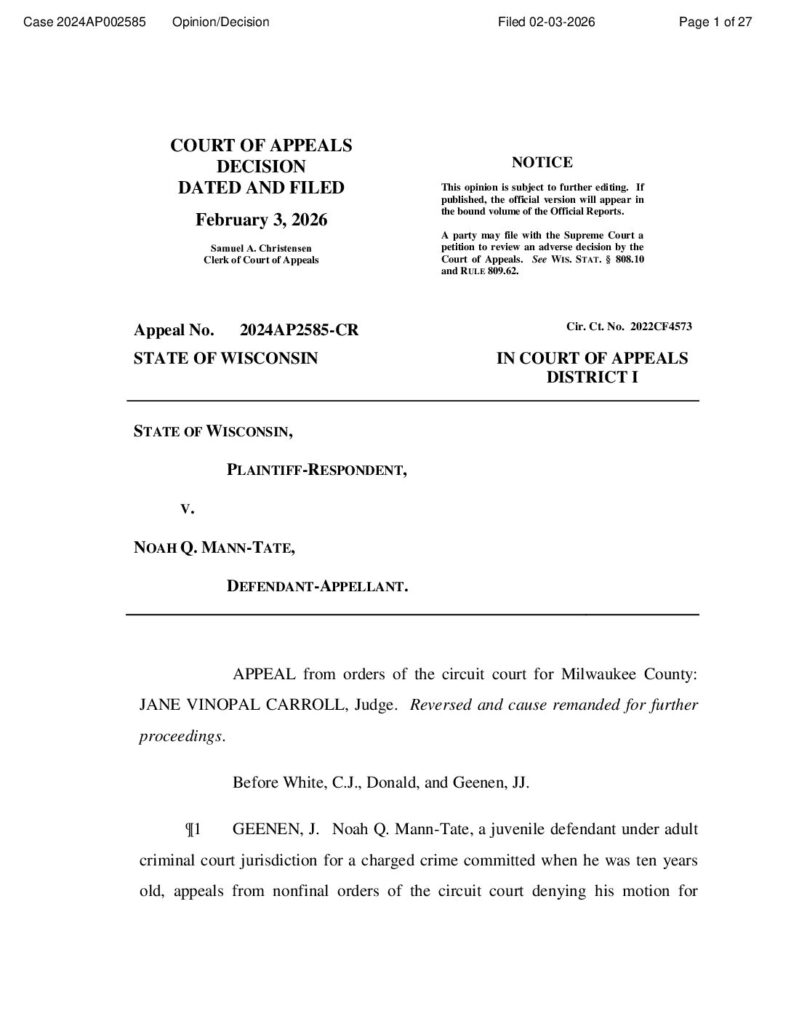
The Court of Appeals of Wisconsin held that the state’s reverse waiver statute was unconstitutional “to the extent it does not require circuit courts to consider the unique attributes of youth identified by the United States Supreme Court.” In Wisconsin, a youth’s case that is directly filed in adult criminal court may be sent to…
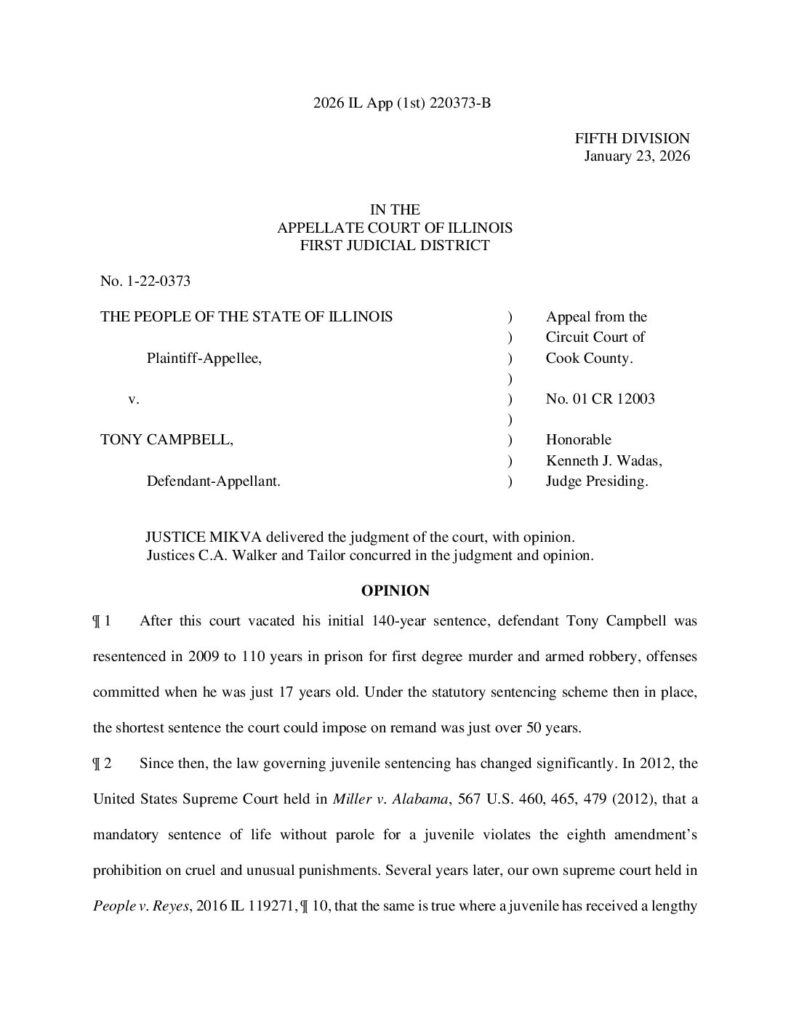
The Illinois 1st District Court of Appeals vacated a 110-year sentence, finding an Eighth Amendment violation. The court stated in relevant part: “One factor that Miller requires a court to consider before it imposes a life sentence is “the juvenile defendant’s degree of participation in the homicide and any evidence of familial or peer pressures that…
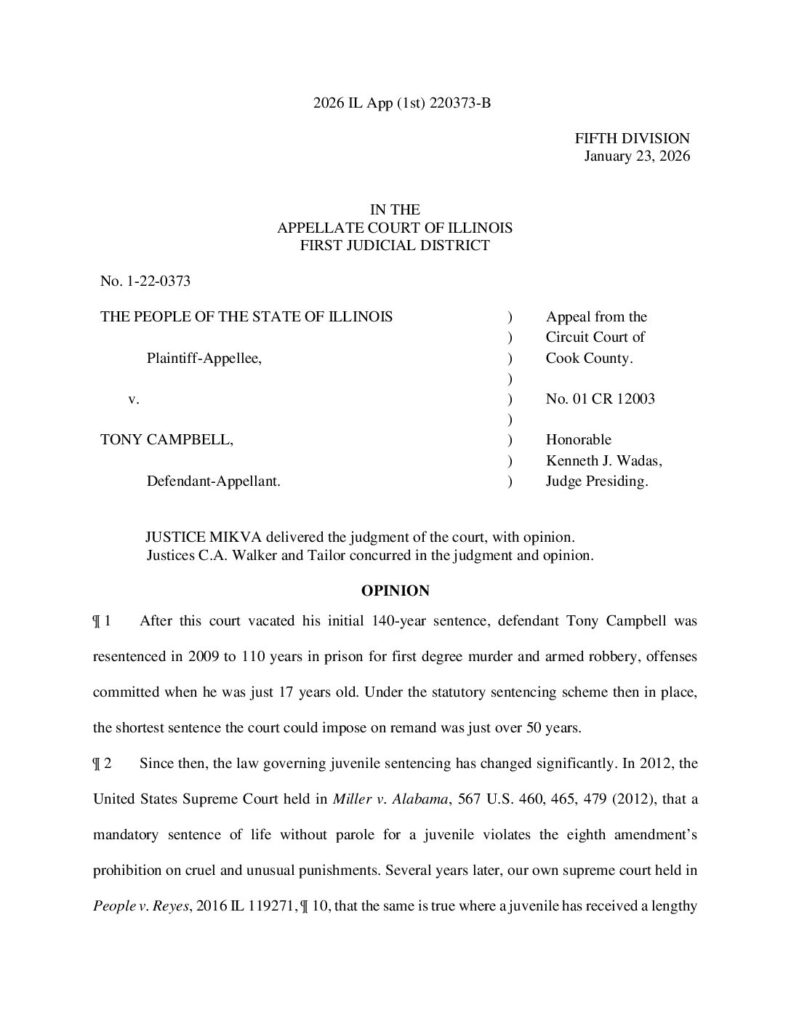
The Illinois Court of Appeals held that where a minimum sentence available by statute was a de facto life sentence, the sentencing scheme violates the Eighth Amendment under Miller and remanded the case for a new sentencing hearing. The court reasoned in relevant part: “The holding in Miller is rooted in society’s growing awareness that even brutal…
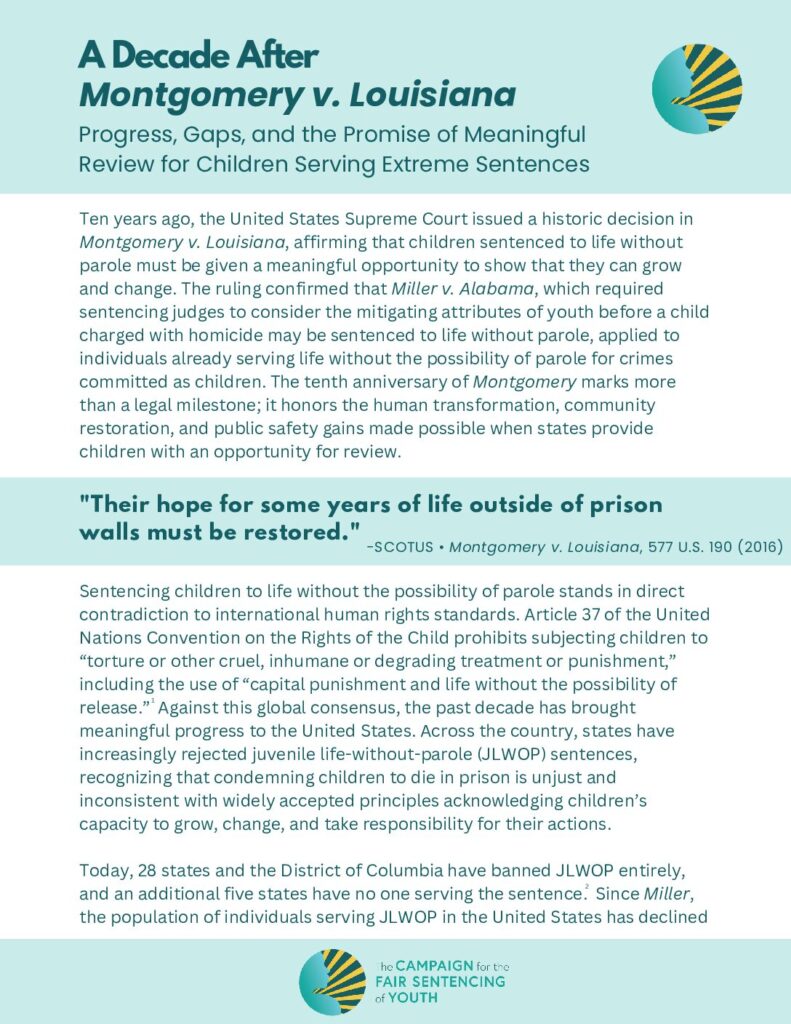
This report from the Campaign for the Fair Sentencing of Youth provides a national overview of the progress states have made in changing juvenile sentencing law and providing meaningful resentencing opportunities for young people ten years after Montgomery. From the resource: Ten years ago, the United States Supreme Court issued a historic decision in Montgomery…

“ American prisons are a black box: remote, austere, and cruel. Although basic demographic data about the people confined in prisons are common—that is, data on the number of people incarcerated, their age, or their race—there is little information available to the public regarding conditions of confinement. A natural response to this data deficit is…
The California Supreme Court held that the imposition of punitive fines and ancillary costs ordered as part of a criminal sentencing raises equal protection issues that require courts to consider ability to pay before imposing fines and costs. The Court stated in relevant part: “In sum, in light of the Legislature’s provision of fee waivers…

The Second District Court of Appeals in Illinois vacated a 66-year sentence finding that the trial court misinterpreted youth-related statutory factors as aggravating instead of mitigating factors. The court stated in relevant part: “Defendant also argues that the trial court incorrectly interpreted the statutory factor of his ability to consider the risks and consequences of…
The 6th Circuit Court of Appeals reversed the district court’s summary judgment order, finding sufficient evidence for constitutional harm where a jail fails to classify or reclassify individuals who are detained based on their histories, leading to multiple assault incidents in the jail. The court stated in relevant part: “A municipality can be held liable…

The Michigan 1st District Court of Appeals vacated second-degree murder and assault with the intent to commit murder sentences for an individual who was 18 years old at the time of the incident and remanded with instructions for the trial court to consider youthfulness and its attendant characteristics as mitigating factors. The court stated in…

“In the period of the 1960s through 2015, the U.S. Supreme Court issued a set of canonical, key decisions expanding the constitutional doctrines of sexual liberty and privacy, equality, and substantive due process for women and sexual and gender minorities. The Court interpreted these principles to protect contraceptive use, abortion, interracial marriage, the private consumption…

“For decades, in the summertime, America has confined certain of its youth in what are essentially open-air heat camps. In city after city, camp-form is established through the enactment of warm-weather juvenile curfews which keep the youth at home or in state-sponsored centers during summer nights and, increasingly, during days as well. Local governments justify…

“Life without parole is the harshest sentence a minor can receive for a homicide offense. Florida is one of a few states that still allow this type of sentence for minors. This sentence violates the Eighth Amendment of the Constitution because it is a cruel and unusual punishment as it locks up a minor for…


From the introduction: “Youth justice advocates, including lawyers, organizers, and other youth and adult movement builders, want to replace the current damaging, discriminatory, and ineffective juvenile and criminal legal systems1 with better approaches. We envision approaches that support children, help them f lourish, and contribute to a safe, equitable, and healthy community. How do we…


From the introduction: “This Article proffers human dignity as a novel conceptual vehicle for capturing and articulating solitary confinement’s harm to personhood. Starting from the Supreme Court’s edict that “the basic concept underlying the Eighth Amendment is nothing less than the dignity of man,” this Article employs a construct of dignity-as-integrity—or wholeness—of personhood. Using dignity-as-integrity…


From the introduction: “Sleep is a biological necessity. If camping on public property is banned across the board, those without access to shelter must unequivocally break the law. Houseless individuals have therefore challenged the constitutionality of anti-camping ordinances on several occasions, particularly under the Cruel and Unusual Punishment Clause of the Eighth Amendment. In a…

Following the 20th anniversary of the Roper v. Simmons decision that ruled the death penalty unconstitutional for youth under the age of 18, the Death Penalty Information Center released a report on the latest science of adolescent brain development and evolving societal standards that recognize the need for heightened legal protections for 18- to 20-year-olds.…
