
Adolescent Development
This op-ed from retired Massachusetts Judge Jay Blitzman advocates for expanding juvenile court jurisdiction in Massachusetts to include 18 to 21 olds. The article draws on developmental neuroscience research from the Center for Law, Brain & Behavior at Massachusetts General Hospital, recidivism data, and information about Massachusetts’s current juvenile court structure and capacity to take on additional youth between…
The District of Columbia Court of Appeals held the sentencing court erred in setting aside Appellant’s conviction under the Youth Rehabilitation Act (YRA) where the court did not weigh Appellant’s age at the time of the offense in his favor and misapplied several other factors. The court stated in relevant part: “In amending the YRA…

Abstract: “Records generated by youth legal systems—or “juvenile justice systems”—are increasingly being used against young people in immigration proceedings. This practice undermines the core purpose of these youth-focused systems and can have devastating, life-altering consequences, including the denial of immigration benefits or deportation. Juvenile justice systems in the United States are founded on the recognition…
This amicus brief from over 26 juvenile justice amici, including the Gault Center, , argues 1) the spirit and text of New York’s passage of landmark Raise the Age Law rejects the attitudes that underlay the Juvenile Offender Act of 1978, 2) New York’s Raise the Age Law and its legislative history demands a youth subject to adult prosecution only in “extremely rare and exceptional cases”, 3) before courts…

This memo from Fenton Communications Agency provides youth advocates with messaging strategies to respond to the D.C. Crimes Act and the Juvenile Sentencing Reform Act pending in Congress. The memo includes succinct responses to questions posed about public safety, youth crime, and transfer laws. The memo also provides suggested talking points on tone and relevant…

The Illinois appellate court reversed the trial court’s sentence of 14 years for an aggravated driving under the influence and reckless homicide conviction based on defense counsel’s failure to produce evidence related to youth-based factors in mitigation. The court offered the following language in support. “Because defendant was a minor when the crash occurred, the…


The Health and Reentry Project highlights promising Medicaid policy changes that promote continuity of care for young people returning to their communities following incarceration. The changes will support reentry for young people who are eligible for Medicaid or the Children’s Health Insurance Program by introducing them to services that would start 30 days before release…
This memorandum from the Public Defender Service for the District of Columbia discusses the contemporary research and literature on electronic monitoring and its impacts on school attendance, family, and employment. The memorandum also discusses the real-world practicalities that make it difficult for youth to comply with the restrictive rules that often accompany electronic monitoring orders. From the memorandum: “The literature regarding the electronic monitoring of youth with disabilities has not yet been fully synthesized to…


From the introduction: “We know how to support transgender youth. Policies, practices, and care that accept and affirm young people’s gender identities can help transgender young people thrive. Research clearly shows that support and acceptance from parents, using young people’s chosen names, enacting inclusive policies and practices at schools and in the community, and providing…

From the abstract: “Hundreds of thousands of children are brought under the jurisdiction of delinquency courts every year in the United States. Despite the reality that most children engage in delinquent behavior during their adolescence, poor children, children of color, children with disabilities, and children who identify as LGBTQIA+ comprise a disproportionate number of those who become delinquency system-involved. These disparities exist…

The Oregon Court of Appeals reversed the adjudication finding of the trial court, holding that there was insufficient evidence to support a finding that the youth intended to damage playground equipment. The Court of Appeals offered the following language in support: “There is an appreciable difference between intentional action—that is, acting with a conscious objective…

From the introduction: “Youth justice advocates, including lawyers, organizers, and other youth and adult movement builders, want to replace the current damaging, discriminatory, and ineffective juvenile and criminal legal systems1 with better approaches. We envision approaches that support children, help them f lourish, and contribute to a safe, equitable, and healthy community. How do we…
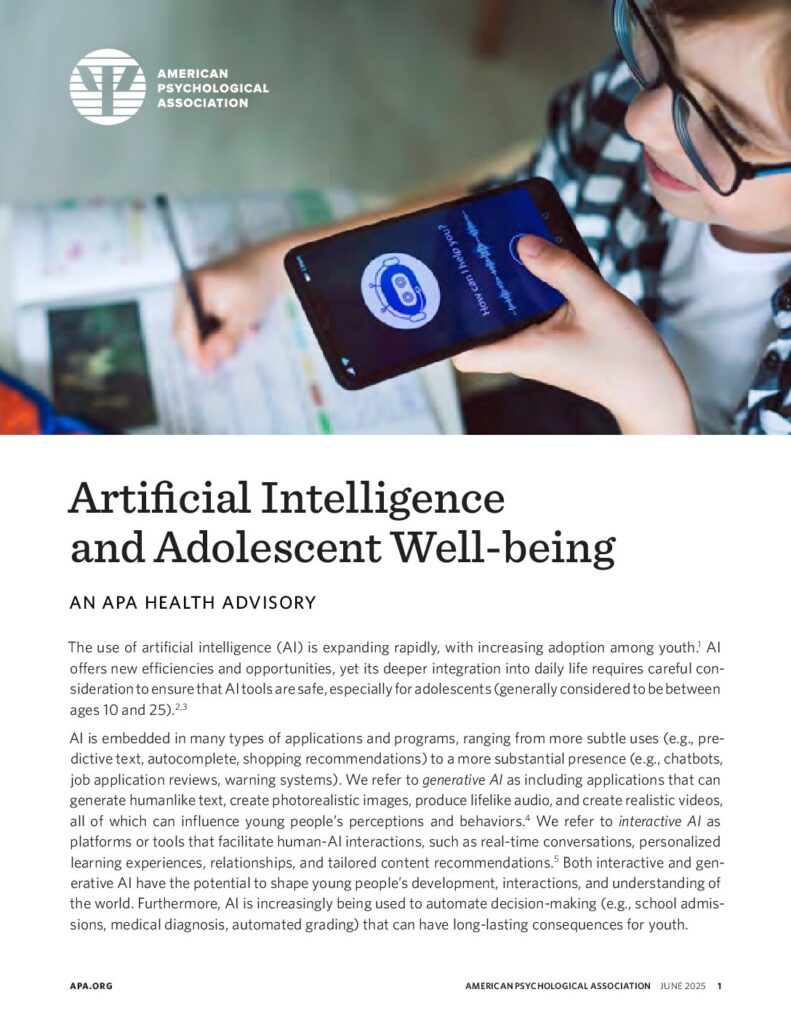
The American Psychological Association’s health advisory examines the growing use of AI among youth. While AI offers many benefits, its increasing role in children’s daily lives requires careful consideration. Because AI is embedded in many applications that shape perceptions and behaviors, it can have lasting impacts on children’s development. The advisory outlines these potential risks and offers recommendations to…

Professor Kris Henning and Rebba Omer authored a law review article on decriminalizing normal adolescent behaviors, race, and disabilities. This article maps a way forward for all system actors in the juvenile legal system to mitigate and buffer against the harms of juvenile legal system involvement for youth with disabilities. Specifically, this article outlines youth…


This resource is part of the Youth Defender Advocacy Program (YDAP) curriculum, a specialized trial advocacy training program for youth defenders.


The Supreme Court of Montana reversed a trial court’s decision denying a sentence reduction for a young adult who was convicted of a homicide offense when he was 16 years old. Noting that transferring a youth to adult court cannot mean that the state “forget[s] about his age,” the Court relies on the juvenile court…


From the conclusion: “The years between 16 and 25 are an important window to build pathways toward a thriving adulthood. By later adolescence, we have the cognitive abilities and social understanding to connect with others and navigate the world in new ways. We have new agency to pursue our own goals and new responsibilities that…

