
Disposition
In re J.D., the Appellate Court of Maryland vacated the circuit court’s imposition of a suspended commitment to the Department of Juvenile Services because this dispositional option is not authorized by the Maryland Rules or the Juvenile Causes Act. The court offered the following language in support: “In our review of the Juvenile Causes Act, we found the statute to be clear and unambiguous. It plainly provides for three types of disposition: probation, commitment…

This memorandum proposes language for a detention and disposition reform bill in California. The memorandum proposes four areas the detention reform bill aims to change including: 1) clarifying the legal standard for pre-adjudication detention of youth, 2) clarifying the juvenile court’s authority to determine whether pre-adjudication detention is still necessary, 3) clarifying the standard at…
The Court of Appeals of Ohio, Eighth District, held that the trial court erred when it did not permit D.C. an opportunity to speak on his own behalf during the dispositional hearing, particularly when the trial court emphasized D.C.’s purported lack of remorse. The court stated in relevant part: “While appellant’s counsel spoke on his…

The Georgia Court of Appeals reversed a part of the adjudication and vacated the order of disposition based on insufficient evidence. The court stated in relevant part: “As to the second count of aggravated assault, K. R. argues that there was insufficient evidence to show that the nail clippers were an object that was likely…

This is a sample “youth report to the court” document (created by a Juvenile Court Judge in Iowa), for youth who are currently under the juvenile court jurisdiction. This report is provided to young people when they appear in court, asking if they would like the space to share pertinent information and ask questions of…
The Ohio Court of Appeals, Fourth Appellate District, held that the trial court erred in accepting I.R.M.’s plea because she did not validly waive her right to counsel, proceeded to disposition without a parent, guardian or custodian present, and abused its discretion by placing I.R.M. in a facility for six months. The court stated in…

This report from Vera Institute for Justice provides examples of reforms from various states that are working to reduce the incarceration of girls in detention and long-term placement. “Over the last decade, as a direct result of focused efforts by youth advocates and a growing body of research on developmentally appropriate practices, many states have…

The Oregon Court of Appeals held that a plea colloquy has to affirmatively demonstrate that a young person understands the “consequences of an admission, including the maximum disposition associated with it”. The court stated in relevant part: “For an admission by a youth to be valid, the youth must be aware, in a manner consistent…
The Missouri Court of Appeals, Western District held that courts must ensure that a juvenile court admission is voluntarily, knowingly and intelligently made, and requires the court to establish a factual basis. The court stated in relevant part: ““A plea of guilty is constitutionally valid only to the extent it is ‘voluntary’ and ‘intelligent.’” Booker…
Abstract: “Records generated by youth legal systems—or “juvenile justice systems”—are increasingly being used against young people in immigration proceedings. This practice undermines the core purpose of these youth-focused systems and can have devastating, life-altering consequences, including the denial of immigration benefits or deportation. Juvenile justice systems in the United States are founded on the recognition…

The Gault Center released an update on the state of youth defense in Kansas, which centers the perspectives and experiences of young people impacted by the juvenile legal system, through a collaborative effort with Progeny, a youth-adult partnership in Kansas, TerraLuna Collaborative, a research consulting group, and Mulberry Art Gallery, which focuses on supporting emerging…

Walks through practical and concrete steps juvenile court judges can take to ensure safe and equitable access to courts for noncitizen and immigrant youth.
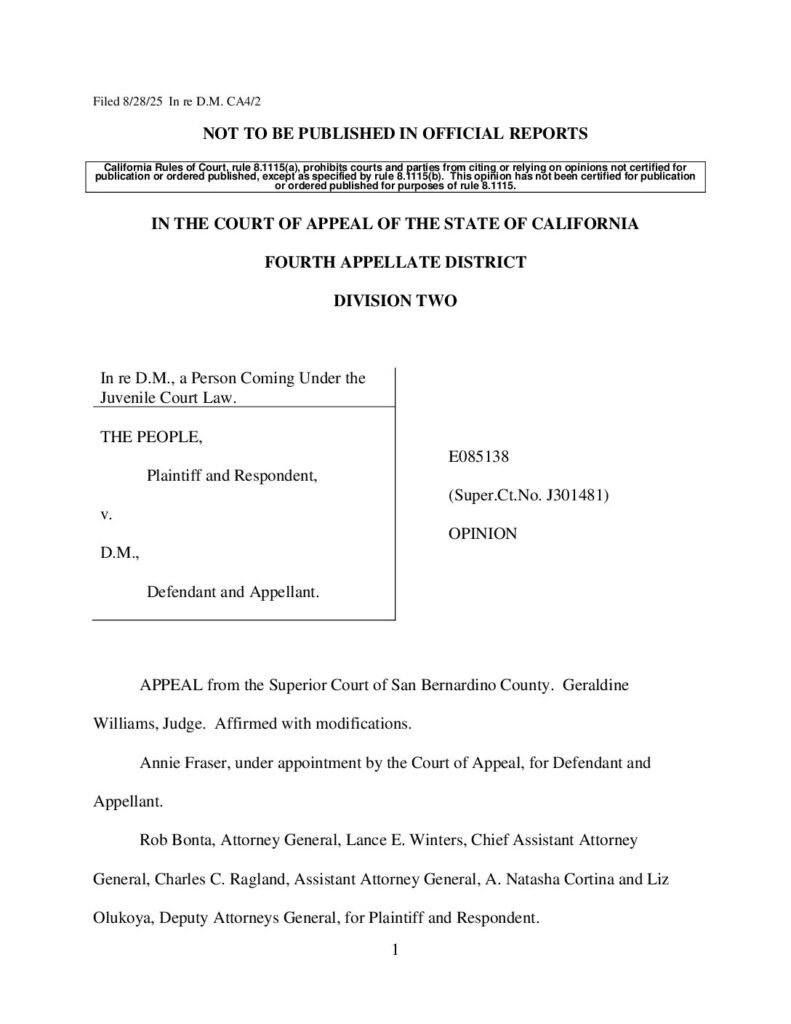
The 4th District Court of Appeal in California struck a weapons probation condition and modified an association condition and offered the following language in support. “A term of probation is invalid if it: “‘(1) has no relationship to the crime of which the offender was convicted, (2) relates to conduct which is not in itself criminal, and (3) requires…

A California appellate court reversed a juvenile court’s disposition order committing a youth to a secure youth treatment facility and offered the following language in support. “Before committing a minor to a secure facility, the court must find no less restrict alternative disposition is suitable. In making this determination, “the court shall consider all relevant…


From the abstract: “The discipline of public health has begun to recognize the structural inequities of the carceral system as drivers of poor individual and population health. Thenumberofpeopleincarceratedandthelengthoftheirincarcerationdeterminethescopeandgravityoftheirexposureto these individual and public health effects. Plea bargains all but guarantee a period of incarceration, often for many years, because prosecutors have significant bargaining power against defendants…
