
Disposition
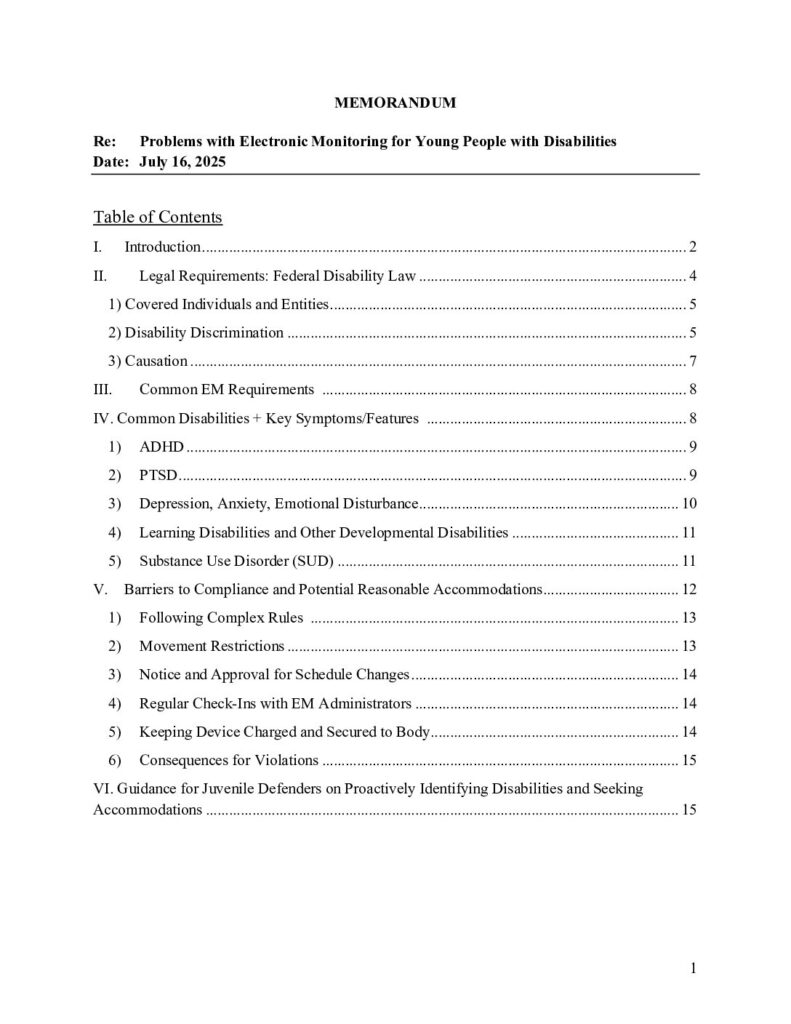
This memorandum from the American Civil Liberties Union provides litigation strategies for defenders challenging electronic monitoring conditions for young people with disabilities. From the Introduction to the memorandum: “Overall, this research project/memo aims to reduce the use of EM for kids with disabilities. Although there is no straightforward disability or accommodations-related argument for ending EM…


From the introduction: “Youth justice advocates, including lawyers, organizers, and other youth and adult movement builders, want to replace the current damaging, discriminatory, and ineffective juvenile and criminal legal systems1 with better approaches. We envision approaches that support children, help them f lourish, and contribute to a safe, equitable, and healthy community. How do we…

Professor Kris Henning and Rebba Omer authored a law review article on decriminalizing normal adolescent behaviors, race, and disabilities. This article maps a way forward for all system actors in the juvenile legal system to mitigate and buffer against the harms of juvenile legal system involvement for youth with disabilities. Specifically, this article outlines youth…


On April 9, 2025, the Oregon Court of Appeals found that a probation condition ordering a youth “to follow probation conditions as designated by OYA [the Oregon Youth Authority]” was legally insufficient to determine whether a young person violated a term of their probation. The Court explained, “without knowing what probation conditions OYA had actually…


In August 2024, the Office for Access to Justice hosted a convening on youth defense, calling attention to the urgent need to invest in youth defense specialization. “Such investments from the state and federal level are essential to safeguarding young people’s constitutional rights. Well-trained and specialized counsel help young people understand their rights as they…


This report from National Institute for Criminal Justice Reform offers six principles of a positive youth justice system (‘PYJS’) including: 1) Minimize contact with the juvenile justice system, 2) partner with youth and families to develop and share ownership of case plans, 3) community-based organizations should take the lead, 4) build on youth assets and…

The Office of Juvenile Justice and Delinquency Prevention and the National Institute of Justice released a fact sheet highlighting key delinquency caseload trends from 2021. There were 437,300 delinquency cases in the United States, down by 39% from 2020, contributing to an overall decline in delinquency cases since its peak in 1997. In 2021, 44%…


A sample memorandum of understanding (MOU) between the Hamilton County Juvenile Court detention center and a community mental health service provider.

A sample disposition and mitigation memorandum filed in a juvenile court in Ohio.


This one-page infographic from the Office of Juvenile Justice and Delinquency Prevention illustrates trends in delinquency cases in 2022.


From the memorandum opinion: “Two men on lifetime parole claim they face disability discrimination from two federal agencies that supervise them. So these men, William Mathis and Kennedy Davis (together, “the Parolees”), now sue those federal agencies, the U.S. Parole Commission and the Court Services and Offender Supervision Agency, and the heads of those agencies…
