
Sentencing

The Michigan 1st District Court of Appeals vacated second-degree murder and assault with the intent to commit murder sentences for an individual who was 18 years old at the time of the incident and remanded with instructions for the trial court to consider youthfulness and its attendant characteristics as mitigating factors. The court stated in…

This report, written by the Sentencing Project, highlights the harmful practice of direct file, or “auto-charging” youth in adult court. This national analysis looks at the practice of direct file and the pervasive harms that it has on the wellbeing and future thriving of young people and makes recommendations for states to limit pathways for…
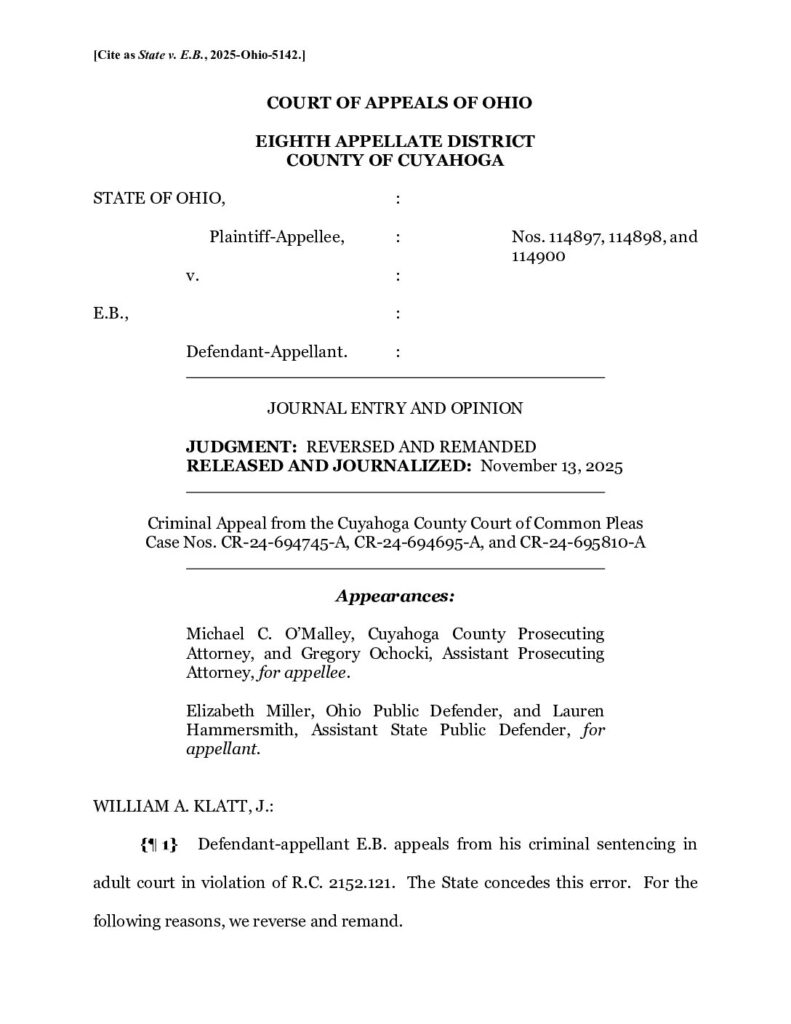
The Court of Appeals of Ohio, Eighth District, found that the trial court erred in failing to stay E.B.’s sentencing and failed to order the case be returned to juvenile court, where E.B. was transferred to adult court but ultimately pled guilty to offenses that would not have required mandatory transfer. Additionally, the Court of…

The First District Court of Appeal in California held that defense counsel was ineffective for failing to present mitigation evidence at a resentencing hearing. The court stated in relevant part: “The judge might also have struck the enhancement as a reasonable response to the evidence of defendant’s intellectual disability and the abuse or neglect he…

The Oregon Court of Appeals held that a plea colloquy has to affirmatively demonstrate that a young person understands the “consequences of an admission, including the maximum disposition associated with it”. The court stated in relevant part: “For an admission by a youth to be valid, the youth must be aware, in a manner consistent…

This memo from Fenton Communications Agency provides youth advocates with messaging strategies to respond to the D.C. Crimes Act and the Juvenile Sentencing Reform Act pending in Congress. The memo includes succinct responses to questions posed about public safety, youth crime, and transfer laws. The memo also provides suggested talking points on tone and relevant…

This report highlights D.C. transfer laws and discusses the current U.S. Attorney’s argument that the District of Columbia should amend its law to transfer more young people to to adult court. The report compares D.C.’s transfer law to transfer laws across the country and highlights decades of research that has concluded transfer laws do not…

This issue brief by the Juvenile Justice Initiative provides an overview of transfer laws in Illinois. Additionally, the brief reviews demographic data on young people who are being tried as adults and identifies the ways that transfer fails children and public safety in the state of Illinois. The brief ends by calling for a return…

The Illinois appellate court reversed the trial court’s sentence of 14 years for an aggravated driving under the influence and reckless homicide conviction based on defense counsel’s failure to produce evidence related to youth-based factors in mitigation. The court offered the following language in support. “Because defendant was a minor when the crash occurred, the…


From the abstract: “The discipline of public health has begun to recognize the structural inequities of the carceral system as drivers of poor individual and population health. Thenumberofpeopleincarceratedandthelengthoftheirincarcerationdeterminethescopeandgravityoftheirexposureto these individual and public health effects. Plea bargains all but guarantee a period of incarceration, often for many years, because prosecutors have significant bargaining power against defendants…

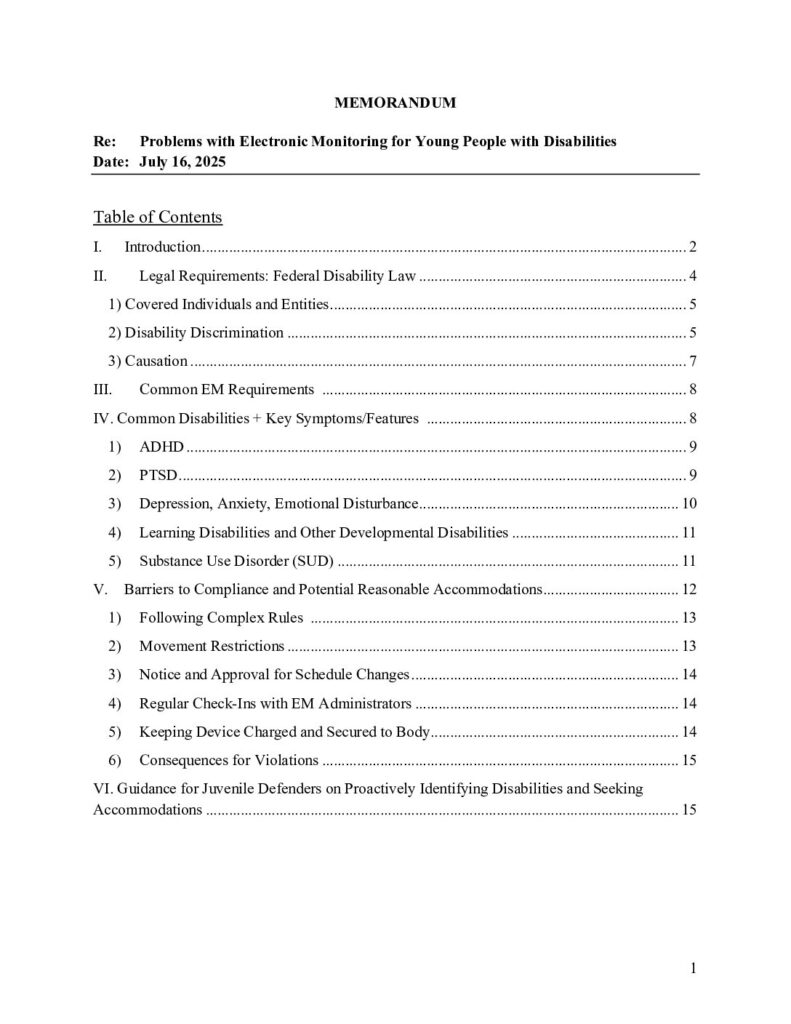
This memorandum from the American Civil Liberties Union provides litigation strategies for defenders challenging electronic monitoring conditions for young people with disabilities. From the Introduction to the memorandum: “Overall, this research project/memo aims to reduce the use of EM for kids with disabilities. Although there is no straightforward disability or accommodations-related argument for ending EM…

This technical assistance bulletin was created by the National Council of Juvenile and Family Court Judges (NCJFCJ) focuses on the practices of judicial transfer, blended sentence and reconsideration hearings and underscores the impact of adolescent development and other factors that courts should consider when making transfer or certification decisions. From the bulletin: “As is evident…


From the abstract: “This paper explores the inequitable treatment of the Intellectually and Developmentally Disabled and Autistic (IDD/A) population in the criminal justice system. Although progress has been made over the past century with understanding the unique needs of this population, they still face challenges at all stages of the criminal justice system. Behavioral, social…


On April 9, 2025, the Oregon Court of Appeals found that a probation condition ordering a youth “to follow probation conditions as designated by OYA [the Oregon Youth Authority]” was legally insufficient to determine whether a young person violated a term of their probation. The Court explained, “without knowing what probation conditions OYA had actually…
