

This brief by the Black Attorneys of Legal Aid, Bronx Defenders, and Brooklyn Defenders was filed in support of petitioners in the Bruen case. The brief points to the racialized history of denying Black and Latine people lawful licenses to carry guns and outlines racial disparities in gun possession cases. Amici submit this brief “because we…

The landmark case Miranda v. Arizona (1966), the United States Supreme Court required law enforcement agencies to advise all suspects of their “Miranda warnings,” or Constitutional protections, prior to interrogation. Previous research demonstrates that the Miranda warnings in the United States are largely unregulated and highlights how inadequate translations can impact comprehensibility. The present study…

From the abstract: “The term wrongful conviction typically refers to the conviction or adjudication of individuals who are factually innocent. Decades of research has rightfully focused on uncovering contributing factors of convictions of factually innocent people to inform policy and practice. However, in this paper we expand our conceptualization of wrongful conviction. Specifically, we propose…

This article from Education Week examines the implications of the Pasco County sheriff’s office in Florida using school data and records from the Department of Children and Families to create a list of students that were “at-risk for a life of crime.” Data privacy experts shared with the media that the actions of the Sheriff’s…

This resource is part of the Youth Defender Advocacy Program (YDAP) curriculum, a specialized trial advocacy training program for youth defenders.

From the introduction: “Communities across the country have come together to demand meaningful changes to law enforcement practices in the wake of the tragic murders of George Floyd, Breonna Taylor, and Rayshard Brooks at the hands of the police. The focus has rightly been on how deadly police actions have had an outsized impact on…

From the abstract: “Today’s left social movements are challenging formal law and politics for their capitulation to a regime of racial capitalism. In this Feature, I argue that we must reconceive our relationship to reform and the popular struggles in which they are embedded. I examine the turn of left social movements to “non-reformist reforms”…


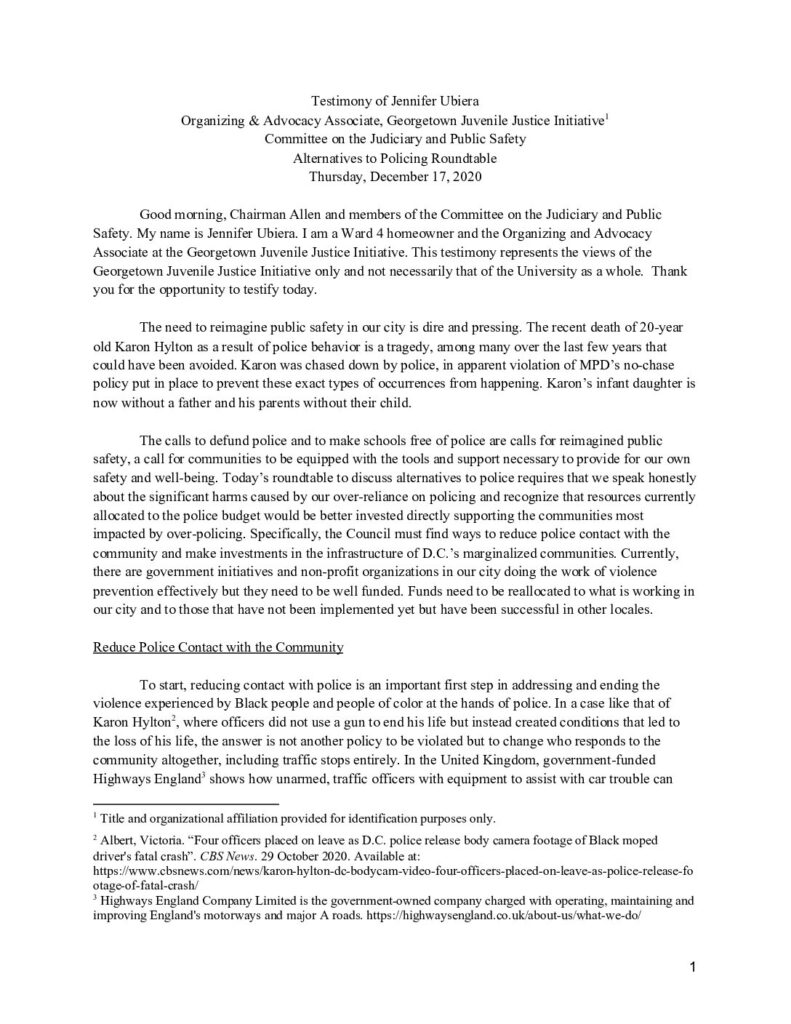


From the introduction: “Black girls and other girls of color are often subjectively punished and criminalized for their communication styles, their expressions, and the trauma they have experienced. It is imperative as policy leaders to advocate for the necessary resources, laws, policies and practices that work to create supportive learning environments, where all students have…

This is a sample motion from Maryland asking the court to exclude tangible evidence recovered during a stop and arrest based on lack of probable cause for the search. The motion includes arguments about implicit racial bias, structural racism, procedural justice, racial justice, and adolescent brain development.

From the abstract: “As the largest minority group in the United States, Latinas/ os have experienced a long history of discrimination, prejudice, and stigmatization as gang members. A contemporary survey of law enforcement agencies reported that Latinos continue to be the largest proportion of any racial or ethnic group involved in gangs. To describe such…

The D.C. Court of Appeals reversed Mr. Miles’s convictions after concluding the police lacked reasonable suspicion to subject him to a Terry stop. Distinguishing the case from Wardlow v. Illinois, the Court found the anonymous tip and the circumstances around Mr. Miles’ flight from the police were not indicative of criminal activity and offered the following language in support: “While Wardlow is not directly controlling here, the case…

“In this article, we address the question left unanswered by the Court in J.D.B.: In light of the substantial research establishing that children’s understanding and appreciation of the Miranda warnings are quite limited, must the traditional test for assessing the validity of an individual’s waiver of their Miranda rights be re-calibrated to take into account…

This study examines the role of perceived phenotypic racial stereotypicality and race-based social identity threat on racial minorities’ trust and cooperation with police. We hypothesize that in police interactions, racial minorities’ phenotypic racial stereotypicality may increase race-based social identity threat, which will lead to distrust and decreased participation with police. Racial minorities (Blacks, Latinos, Native…


On November 28, 2016, the DOJ filed a Statement of Interest in response to a lawsuit filed in South Carolina, challenging two state statutes as void for vagueness in violation of the Due Process Clause. The lawsuit alleged that the vague language in the statute resulted in the criminalization of common youthful behavior, racial disparities,…

The New York Supreme Court Appellate Division reversed the judgement and conviction, vacated the plea, and granted the motion to suppress all evidence after finding the police lacked an objective, credible reason to justify an initial approach and request for information. The court, citing a lack of evidence to support the police encounter, offered the following language in support: “In evaluating police conduct, a court “must determine whether the action taken was justified…
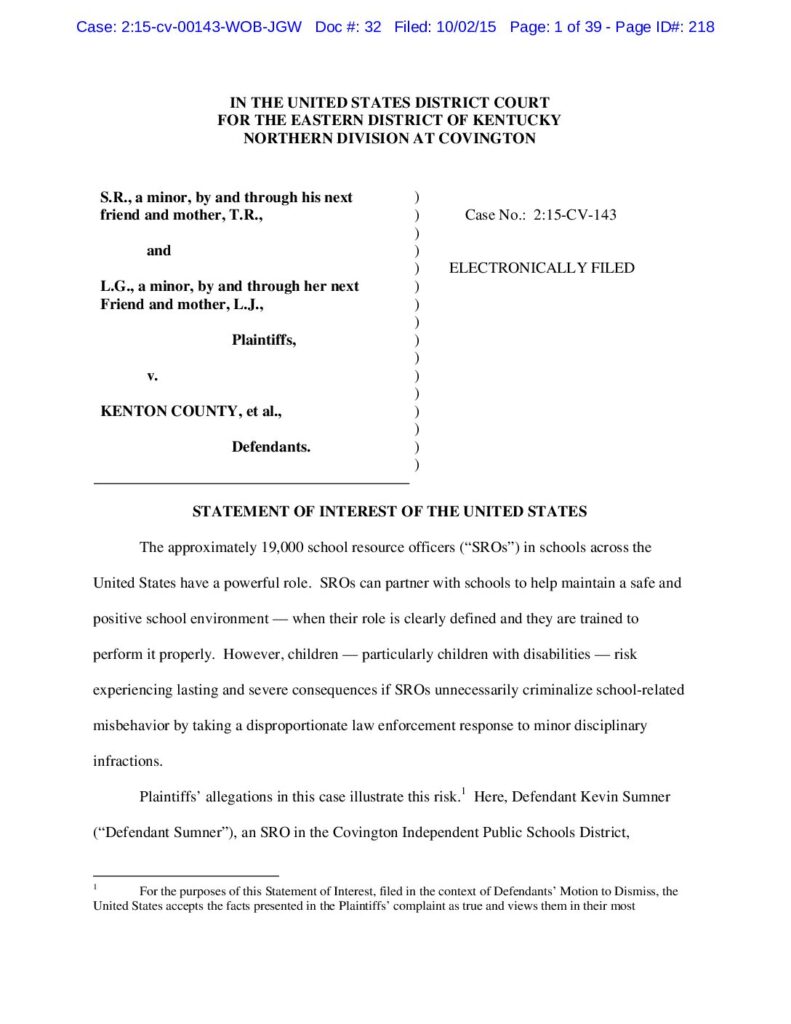
On October 2, 2015 the DOJ filed a Statement of Interest in a federal lawsuit on behalf of two students who were seized and handcuffed by a school resource officer (SRO), alleging violations under the Fourth and Fourteenth Amendments and Title II of the Americans with Disabilities Act (ADA). The DOJ asserted that the Sheriff’s…

On September 18, 2015, the U.S. Department of Justice entered into a settlement agreement with the city of Meridian to address the practice of arresting students in schools. The settlement agreement includes provisions that limit school-based arrests, including “for behavior that is appropriately addressed as a school discipline issue, including incidents involving public order offenses…

This article summarizes a study conducted by Yale Law School, Columbia Law School and Mailman School of Public Health at Columbia University, examining the influence of street stops by police on the legal socialization of adolescents and emerging adults ages 18-26 in New York City. The study showed an association between the number of police…
